
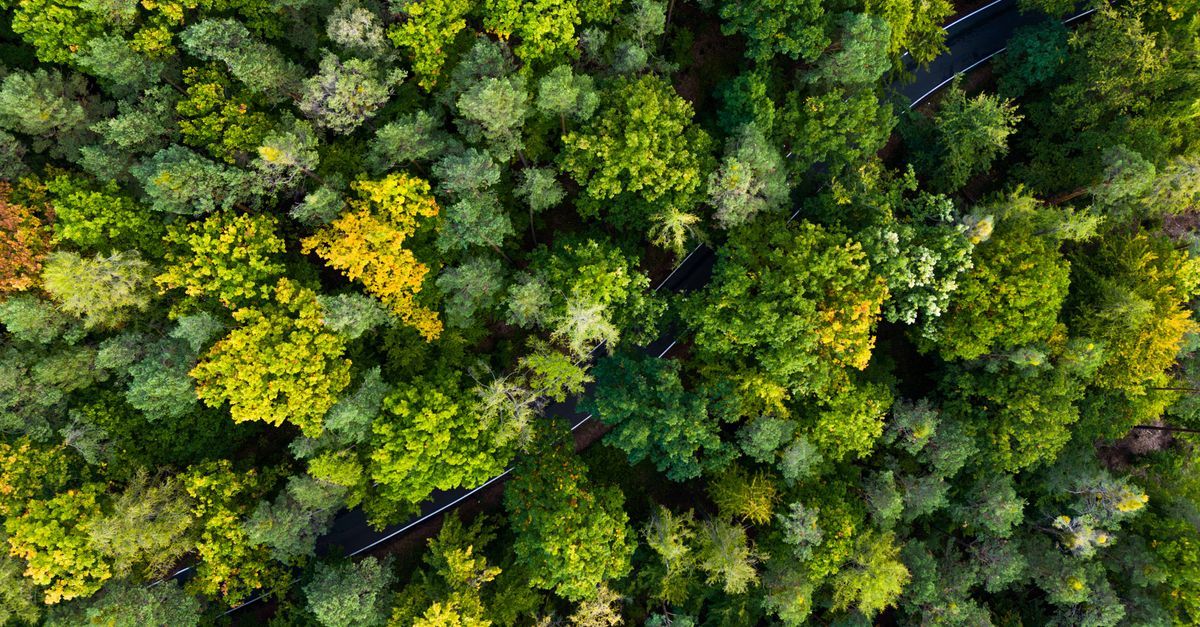
Habitat loss and habitat fragmentation are related but distinct problems. Habitat loss is the outright disappearance of natural habitat. Fragmentation is what happens to whatever habitat remains: a once-continuous forest, grassland, or wetland gets broken up by roads, farmland, or development into smaller, disconnected patches. Even if the total remaining habitat area looks similar on paper, fragmentation on its own creates serious problems for the species living in it.
Why fragmentation hurts wildlife beyond the obvious
A fragmented patch isn't just smaller — its edges behave differently from its interior. "Edge effects" bring more light, wind, temperature swings, and predator or invasive-species activity into what used to be stable interior habitat. Small, isolated patches can also trap wildlife populations too small to maintain healthy genetic diversity, and they can cut off the seasonal movement many species rely on, whether that's a large mammal following food availability or a population of frogs needing to reach a breeding wetland (see our article on migration as a survival adaptation).
What the evidence says about wildlife corridors
Wildlife corridors — strips or patches of habitat connecting otherwise isolated areas — are one of the main tools used to counteract fragmentation. Some of the clearest experimental evidence comes from the long-running Savannah River Site corridor experiments in South Carolina, where researchers created matched pairs of connected and disconnected habitat patches of identical size and compared outcomes over time.
| Measure | Effect in corridor-connected patches |
|---|---|
| Plant reproduction (fruiting) | 69% higher proportion of flowers producing berries in an early experimental study. |
| Long-term plant biodiversity (18-year study) | 14% higher biodiversity and 24 more plant species on average than disconnected patches. |
| Pollinator/seed-disperser movement (proxy measure) | Roughly 20% higher activity indicators in connected versus disconnected patches. |
| "Spillover" effect beyond the corridor itself | Benefits detected extending up to about 30% beyond the corridor's physical boundary in one study, with a 10–18% increase in plant diversity. |
An independent, observational study of breeding birds in northern New York found bird abundance 22.4% higher inside a corridor area compared to outside it — though the researchers noted the result is partly confounded by differences in forest cover and road density, a useful reminder that not every corridor study isolates the corridor's effect as cleanly as the controlled Savannah River Site experiments do.
Where fragmentation is a particular concern
- Temperate grasslands: among the most fragmented biomes globally because of their suitability for agriculture — see our grassland ecosystem article.
- Tropical rainforest edges: roads and agricultural clearing create long, exposed forest edges vulnerable to drying and further degradation.
- River systems: dams fragment river ecosystems longitudinally, blocking migratory fish from reaching spawning habitat — see our river ecosystem article.
- Mountain and alpine zones: species already confined to narrow elevation bands have little room to shift if their habitat is further fragmented by development.
How fragmentation is measured, and how corridors get planned
Conservation scientists rarely describe fragmentation with a single number. Landscape ecologists typically track a handful of linked metrics: average patch size, the ratio of edge length to interior area, the distance between patches, and a "connectivity index" that estimates how easily a given species could realistically move between them. A large patch with a high edge-to-area ratio — a long, thin sliver of forest left standing along a river, for example — behaves ecologically more like an edge habitat than a true interior one, even if its total area looks substantial on a map.
Corridor planning uses these same metrics in reverse: agencies and researchers model which patches are close enough, and similar enough in habitat type, for a target species to move between them, then prioritize connecting the pairs that would do the most to restore landscape-level connectivity. This kind of planning has become a bigger part of international conservation policy. Under the Kunming-Montreal Global Biodiversity Framework, adopted by more than 190 countries in December 2022, Target 3 — often shortened to "30x30" — commits signatories to conserve 30% of land, inland water, and sea areas by 2030, explicitly through "well-connected" networks of protected areas rather than isolated reserves. That single word, "connected," is why corridor science has moved from a niche research topic to a formal piece of national conservation planning in many of those countries.
In practice, corridors range enormously in form: a narrow culvert underpass built to let amphibians and small mammals cross beneath a highway, a managed strip of replanted native vegetation linking two forest reserves, or an entire chain of protected areas spanning several countries, such as corridor initiatives connecting protected areas across Central America. Not every design works equally well — width, vegetation structure, and how much human activity passes through the corridor all affect whether a given species will actually use it, which is why monitoring usage after a corridor is built (not just modeling it beforehand) is considered best practice by conservation planners.
Common mistakes
- Treating habitat loss and fragmentation as the same problem. A landscape can retain a similar total habitat area while fragmentation still causes serious ecological harm.
- Assuming any strip of green connecting two areas functions as an effective corridor. Corridor quality, width, and habitat type all affect whether species actually use it.
- Generalizing a single study site's results to all ecosystems. Much of the strongest quantitative evidence for corridor benefits comes from one well-studied region.
- Assuming a large protected area is automatically well connected. Size and connectivity are different properties — a large reserve can still be an isolated island if nothing links it to other habitat.
Frequently asked questions
What is habitat fragmentation?
Habitat fragmentation is the breaking up of a large, continuous habitat into smaller, isolated patches, usually due to roads, agriculture, or development, which can cut off wildlife populations from each other.
Do wildlife corridors actually work?
Controlled, long-term studies at experimental sites show measurable benefits: one 18-year study found 14% higher biodiversity and 24 more plant species in habitat patches connected by a corridor compared to disconnected patches of the same size.
What kinds of species benefit most from corridors?
Species that need to move seasonally, disperse to find mates, or maintain genetic diversity across a wider population benefit most — wide-ranging mammals, migratory animals, and plants that rely on animal-assisted seed or pollen dispersal.
Is corridor research based on many ecosystems?
Much of the strongest experimental evidence comes from a small number of long-term research sites, notably the Savannah River Site corridor experiments in South Carolina, so results may not transfer identically to every ecosystem.
Sources
- Savannah River Site corridor experiments (PNAS, 2002) — plant reproduction and movement-proxy data, accessed November 4, 2026.
- Long-term (18-year) corridor biodiversity study, Science — plant species richness data, accessed November 4, 2026.
- Corridor "spillover effect" study (PNAS, 2009), accessed November 4, 2026.
- Conservation Evidence — summary assessment of habitat corridor effectiveness research, accessed November 4, 2026.
- Convention on Biological Diversity — Kunming-Montreal Global Biodiversity Framework, Target 3 ("30x30"), adopted December 2022, accessed November 4, 2026.