
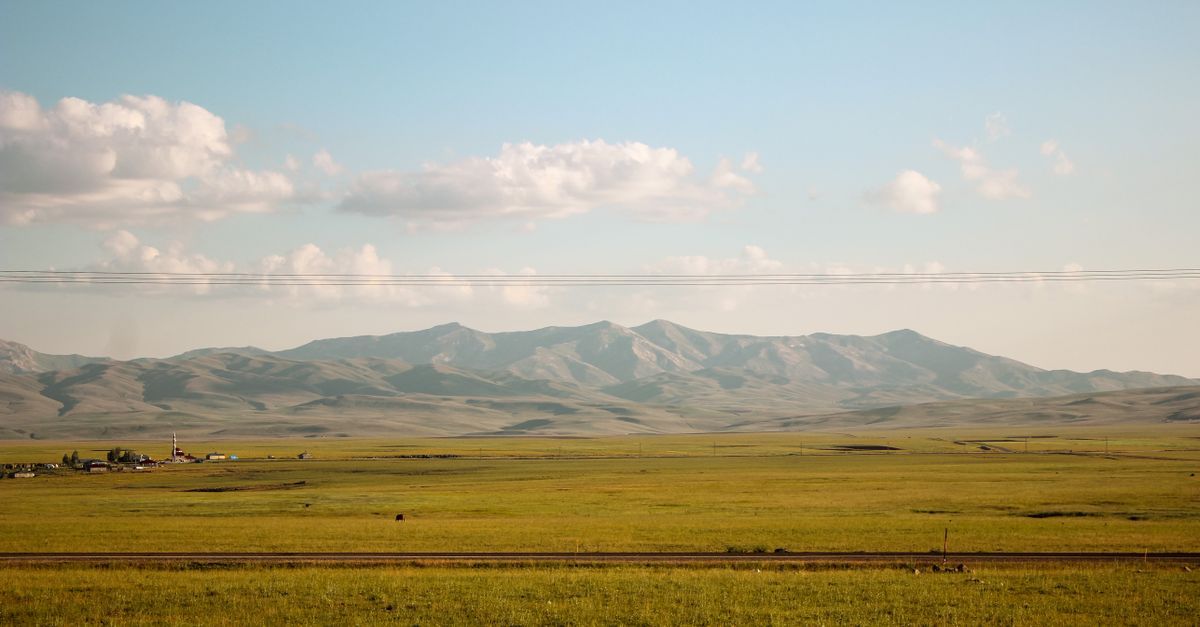
Temperate grasslands sit in a precise climate window: too dry, on average, to support forest, but too wet to be desert. That narrow balance produces one of the most distinctive landscapes on Earth — vast, largely treeless expanses of grass — and some of the planet's most fertile soil.
Known as prairie in North America, steppe in Asia, and pampas in South America, temperate grasslands share a common climate logic even where their specific grasses and wildlife differ. This article covers the climate, soil, fauna, and conservation challenges facing this heavily altered biome.
Climate: moderate rainfall, cold winters, warm summers
Temperate grasslands receive moderate rainfall, roughly 250–750 mm a year, with cold winters and warm summers. That rainfall band is exactly what keeps the biome as grassland rather than tipping into forest (with more rain) or desert (with less). Strong, near-constant wind is also a defining feature of many grasslands, since there is little tree cover to slow it down across these open landscapes.
Soil: some of the most fertile ground on Earth
Deep, fertile soils form here as generations of grass roots die back and decompose rapidly, building up organic matter far faster than a forest's leaf litter does. This is, ironically, part of the biome's biggest conservation challenge: that same fertility is exactly what makes grassland so attractive to convert into cropland.
Productivity: moderate, and dependent on rainfall
Reference estimates put mean net primary productivity for temperate grasslands around 600 g/m²/year, varying with rainfall between drier short-grass prairie and wetter tall-grass prairie. Productivity here is closely tied to year-to-year rainfall variability, more so than in wetter, less rainfall-sensitive biomes.
Flora and fauna of the open grassland
Typical plants include bluestem and other tall grasses, buffalo grass and other short grasses, coneflowers and other wildflowers, and deep-rooted legumes. The American bison (Bison bison) is the biome's most iconic grazer, currently listed as Near Threatened on the IUCN Red List, with its recovery dependent on ongoing conservation management rather than being self-sustaining in the wild (accessed November 4, 2026). Other residents include prairie dogs, pronghorn, burrowing owls, and grassland sparrows.
The grassland food web
Grasses and forbs, as producers, support large grazers like bison and pronghorn and seed-eating rodents like prairie dogs, which are hunted by coyotes, hawks, and owls. Frequent fire and grazing — rather than tree litter decomposition — are the main drivers of nutrient cycling in this biome.
| Adaptation | How it helps |
|---|---|
| Growth point at/below ground | Fire or grazing removes only the above-ground leaf, not the regrowth point |
| Deep, extensive roots | Survive drought and store energy underground |
| Herding behavior in grazers | Reduces individual predation risk across open terrain |
How to recognize a temperate grassland
- Continuous grass cover with few or no trees across large, open areas.
- Dark, deep topsoil visible in any exposed or plowed ground.
- Burrow systems (prairie dog towns, etc.) as a common landscape feature.
- Herding or flocking behavior in resident grazing animals and birds.
- Cold winters distinguishing it from warm-climate savanna.
Threats and conservation
Temperate grasslands are among the most converted biomes on Earth precisely because their deep, fertile soils are so well suited to agriculture. What remains is often fragmented into small, isolated patches, and long-term ecological studies — including at Montana's National Bison Range — document warming and drying trends that are making surviving grassland more fire-prone.
Fragmentation is a particular problem for wide-ranging grazers and the predators that depend on them: a prairie broken into disconnected patches by cropland and roads can no longer support the kind of large, mobile herds that once moved across the landscape following rainfall and fresh grass growth. Prairie dog colonies, which create burrow networks used by dozens of other species from burrowing owls to snakes, are especially vulnerable to fragmentation and are sometimes removed as agricultural pests, which can ripple outward to affect the many other species that rely on the habitat structure those colonies create. Conservation efforts increasingly focus on reconnecting remaining grassland fragments and restoring natural grazing and fire regimes rather than treating each small protected patch in isolation.
Common mistakes
- Assuming grassland means "empty" land. Grasslands are ecologically complex and among the most altered biomes precisely because they're so productive.
- Mixing up grassland and savanna. Grassland is cold-winter and mostly treeless; savanna is warm year-round with scattered trees. See our savanna article.
- Thinking bison recovery is complete. The species remains Near Threatened and dependent on active conservation management, not fully self-sustaining in the wild.
Frequently asked questions
Why is grassland soil so fertile?
Generations of grass roots die back and regrow each year, rapidly building deep, organic-rich soil — among the most fertile on Earth.
Is the American bison endangered?
It is listed as Near Threatened on the IUCN Red List, with its recovery dependent on ongoing conservation management.
What's the difference between a prairie and a savanna?
Temperate grasslands have cold winters and are generally treeless, while savanna is warm year-round with scattered trees among the grasses.
Why do grasses survive fire and grazing so well?
Grasses grow from points at or below ground level, so removing the top of the plant doesn't kill the growth point — it simply regrows.
Why are temperate grasslands disappearing?
They are among the most converted biomes on Earth because their deep, fertile soils are ideal for agriculture, leaving remaining prairie fragmented.
Sources
- IUCN Red List — Bison bison (American bison). Accessed November 4, 2026. iucnredlist.org