
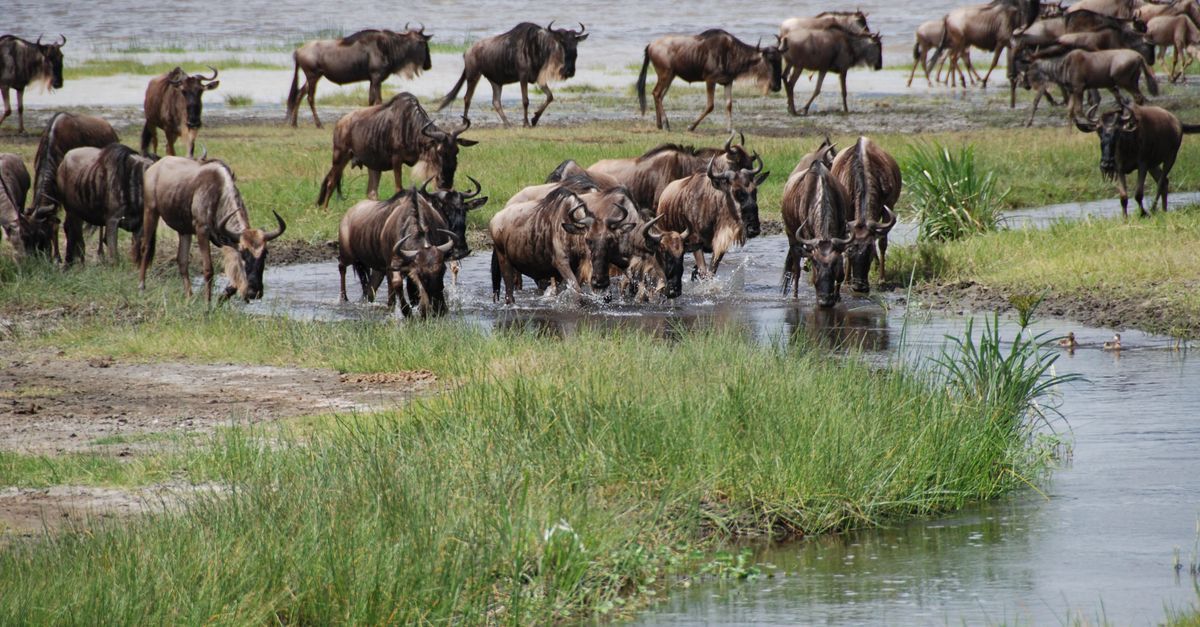
Migration is the regular, often seasonal movement of animals between different habitats or regions, usually to follow resources like food, water, or breeding conditions that shift with the seasons. Unlike dispersal, which is typically a one-way move by individuals away from where they were born, migration is a repeated, often round-trip journey undertaken by many individuals of a species together, year after year.
Migration shows up across nearly every type of ecosystem and at every scale, from a daily vertical journey by microscopic zooplankton to a multi-thousand-kilometer seasonal trek by large mammals.
Savanna migration: following the rain
In savanna ecosystems, rainfall is strongly seasonal — typically 500 to 1,500 mm concentrated in a single wet season — which means grass growth is concentrated in time and space too. Wildebeest and plains zebra respond by migrating long distances to follow seasonal rain and the fresh grazing it produces, timing calving and movement around where water and grass will be available next. This large-scale migration also shapes the broader savanna food web, since predators like lions adjust their own movement and hunting patterns around the seasonal presence of migrating herds.
Migration in polar and open-ocean ecosystems
In polar ice and open-ocean ecosystems, migration often tracks the availability of sea ice or prey rather than rainfall. Seasonal sea-ice extent — the 2025 Arctic winter maximum was the smallest in the 47-year satellite record — structures breeding and feeding migrations for species like emperor penguins, which the IUCN uplisted to Endangered in April 2026, citing sea-ice loss as the primary driver affecting their breeding sites. In the open ocean, many large predators, including tuna and some shark species, undertake long migrations tied to water temperature and prey density, while zooplankton across the world's oceans perform a daily vertical migration — rising toward the surface to feed under cover of darkness and retreating to deeper, darker water during the day to avoid visual predators.
Freshwater and river migration
River ecosystems host some of the most dramatic migrations in the animal kingdom. Many fish species undertake spawning migrations timed to seasonal flow and flooding, moving between different river stretches — or between rivers and the open ocean entirely — to reach the conditions their eggs and young need to survive. Seasonal flood pulses that reconnect rivers to their floodplains are critical for species that use newly flooded areas as spawning habitat, which is one reason dams and flow regulation can disrupt migratory fish populations even when water quality itself isn't degraded.
Why migrate instead of adapting in place?
Migration is, in a sense, a behavioral alternative to physiological adaptation. Rather than evolving to tolerate drought, cold, or food scarcity in one location, migratory species instead evolve the ability — and often an innate or learned route — to simply leave before conditions become unsurvivable. This strategy carries its own costs (energy spent traveling, risks along the route, dependence on multiple habitats staying intact) but can be more efficient than tolerating extreme conditions directly, especially when suitable habitat exists elsewhere at the right time of year.
How animals navigate during migration
| Cue | How it's used | Example group |
|---|---|---|
| Sun or star position | Provides directional reference across large distances | Many migratory birds |
| Earth's magnetic field | Detected internally to maintain heading over featureless terrain or ocean | Sea turtles, some migratory fish |
| Landscape or coastline features | Visual landmarks guide movement along familiar routes | Many land mammals, coastal species |
| Learned/social routes | Younger individuals follow experienced group members | Herd mammals such as wildebeest |
How to identify a migratory adaptation
- Does the movement repeat on a predictable seasonal or daily cycle?
- Does it involve round-trip movement, not a one-way dispersal from a birthplace?
- Is the movement tied to a specific resource (food, water, breeding habitat, temperature)?
- Does it typically involve many individuals of the species moving together?
- Is there evidence of specialized navigation ability (internal compass, landmark learning)?
Common mistakes
- Confusing migration with dispersal. Dispersal is usually a one-way move away from a birthplace; migration is a repeated, often seasonal round trip.
- Assuming migration only happens on land. Daily vertical migration by zooplankton may be the largest animal movement on Earth by total biomass.
- Treating migration routes as fixed forever. Climate change and habitat loss are shifting the timing and viability of many migration routes.
Frequently asked questions
What is the difference between migration and dispersal?
Migration is a regular, often seasonal, round-trip movement between habitats, usually by many individuals of a species at once. Dispersal is typically a one-way movement by individuals away from their birthplace, not tied to a recurring seasonal cycle.
Why do wildebeest migrate across the savanna?
Wildebeest and plains zebra migrate long distances to follow seasonal rainfall and the fresh grass it produces, since savanna rain falls mostly in one concentrated wet season and grazing in one place year-round would exhaust local food and water.
Do ocean animals migrate too?
Yes. Many open-ocean species undertake long migrations, and even zooplankton perform a daily vertical migration, moving toward the surface to feed at night and retreating to darker water during the day to avoid predators.
How do migrating animals navigate over long distances?
Migrating species use a combination of cues depending on the species, which can include the position of the sun or stars, the Earth's magnetic field, landscape or coastline features, and in some cases, learned routes passed down within social groups.
Sources
- NSIDC — Sea Ice Today, accessed November 4, 2026.
- IUCN Red List — Aptenodytes forsteri (Emperor penguin), 2026 reassessment, accessed November 4, 2026.
- USGS — River and floodplain ecology publications, accessed November 4, 2026.
- Eco Animal Life biome dataset (savanna, polar-ice, open-ocean, and river entries). See our methodology.