
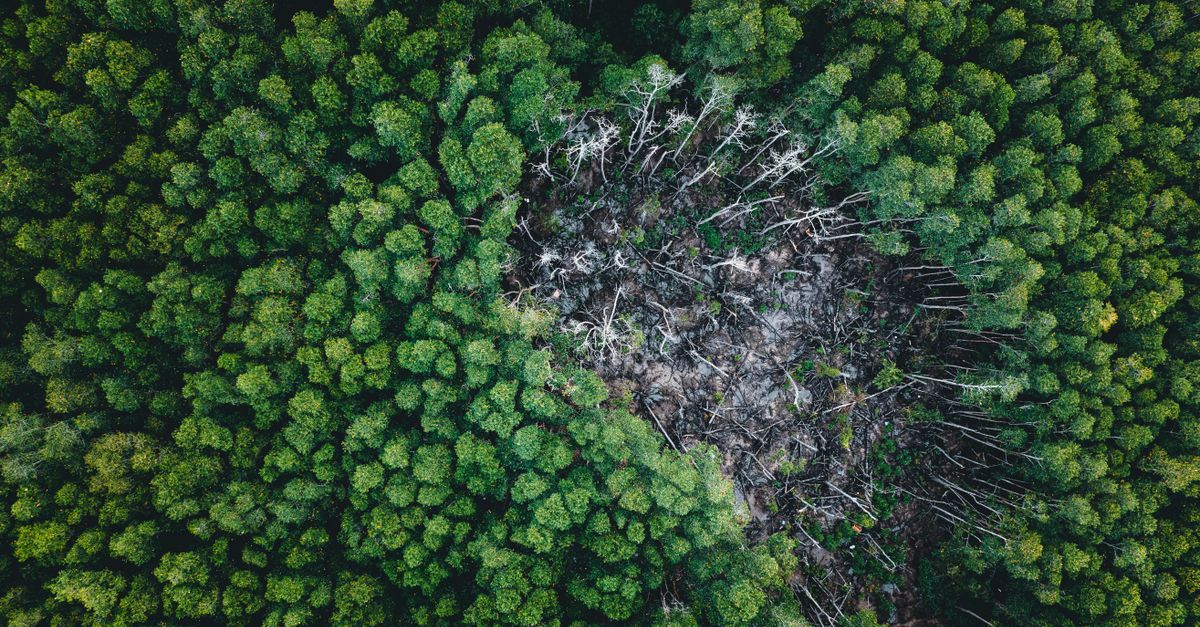
Deforestation is the large-scale removal of forest, usually to convert land for agriculture, grazing, logging, mining, or development. It's one of the most direct and measurable ways that human activity reshapes an ecosystem — and because forests cover such a large share of Earth's land surface and store so much of its biodiversity, the effects ripple far beyond the trees that are cut.
Different forest biomes face different pressures and timelines. Tropical rainforest loss is tracked closely because it's ongoing and large in scale; temperate forest loss, by contrast, is mostly historical in regions like Western Europe; and the taiga, the largest land biome on Earth, is now facing a newer combination of logging and climate-driven wildfire.
How much tropical forest is being lost right now
According to satellite monitoring from Global Forest Watch (a partnership between the World Resources Institute and the University of Maryland), primary tropical forest loss hit a record of about 6.7 million hectares in 2024 — the first year fire, rather than direct agricultural clearing, was the leading driver. Loss then fell by about 36% in 2025 to roughly 4.3 million hectares. That's real progress, but the 2025 rate is still about 46% higher than the average loss rate from a decade earlier, meaning tropical deforestation has slowed, not stopped. For more on the ecosystem itself, see our tropical rainforest article.
Why rainforest soil makes recovery hard
One detail that surprises many people: tropical rainforest soils are typically old, heavily weathered, and nutrient-poor. Most of the ecosystem's nutrients aren't stored in the ground — they're stored in the living biomass itself and recycled rapidly through a thin layer of leaf litter. When the forest is cleared, that nutrient cycle is broken, and the soil left behind often can't support the same forest for decades, even if the land is left alone to regrow.
Deforestation beyond the tropics
| Biome | Main historical or current pressure |
|---|---|
| Tropical rainforest | Ongoing clearing for agriculture and, increasingly, fire — record loss in 2024, easing somewhat in 2025. |
| Temperate forest | Historic clearing for agriculture and settlement already removed most old-growth cover in Europe and much of North America; today, fragmentation and invasive pests are bigger concerns than new clearing. |
| Taiga (boreal forest) | The world's largest terrestrial biome, at roughly 17 million km²; logging and increasingly severe, climate-linked wildfires are the leading current threats. |
What gets disrupted when a forest is cleared
- Habitat and food webs: canopy-dependent species lose nesting and feeding sites, and predator-prey relationships built around forest structure break down.
- Carbon storage: forests, especially tropical ones, store large amounts of carbon in biomass; clearing releases much of it.
- Local rainfall: large forests, particularly in the tropics, recycle moisture back into the atmosphere; widespread clearing can reduce regional rainfall.
- Soil stability: root systems that hold soil in place are removed, increasing erosion and sediment runoff into rivers.
- Habitat connectivity: remaining forest is often left in disconnected fragments — see our article on habitat fragmentation and wildlife corridors.
Fire as a changing driver
One of the more significant shifts in recent monitoring is the growing role of fire. In 2024, fire overtook direct agricultural clearing as the leading cause of primary tropical forest loss for the first time in the Global Forest Watch record — a trend linked to drier conditions in a warming climate, which also plays a role in increasingly severe taiga wildfires farther north.
Which regions drive the losses
Tropical deforestation isn't evenly distributed. Global Forest Watch's satellite record consistently shows Brazil and the wider Amazon Basin, the Congo Basin countries (especially the Democratic Republic of the Congo), and Indonesia as the countries with the largest absolute areas of primary forest loss in most years, though the leading driver differs by region — cattle pasture and soy expansion are closely tied to Amazon clearing, small-scale and shifting agriculture is a larger factor across much of the Congo Basin, and oil palm and pulpwood plantations have historically driven a large share of Indonesian loss, alongside the fire-driven losses recorded across the tropics in 2024. This regional pattern matters for conservation strategy: a policy or certification scheme designed around one driver, like agricultural supply-chain commitments aimed at cattle and soy, won't necessarily slow a different driver, like smallholder clearing, somewhere else.
The downstream effect on wildlife follows the same regional pattern described in our tropical rainforest article: wide-ranging predators like the jaguar in the Americas, already listed as Near Threatened by the IUCN, and great apes like orangutans in Southeast Asia, assessed as Critically Endangered, are especially sensitive to forest loss because they need large, connected territories that fragmented, partially cleared forest can no longer provide.
Quick example: a cleared forest edge
A logging road cut into intact rainforest doesn't just remove the trees along its path — it creates a new forest edge, where wind, sunlight, and dryness penetrate deeper into what was previously closed-canopy interior. Researchers studying forest fragmentation have found that these edge effects can alter microclimate, tree mortality, and species composition for a considerable distance into the surrounding forest, meaning the ecological footprint of a single road or clearing is often far larger than the cleared area itself would suggest.
Common mistakes
- Treating "deforestation" and "forest fire" as unrelated. In the tropics, fire has become a leading direct cause of forest loss, not just a secondary effect.
- Assuming a 36% drop in loss means deforestation has stopped. The 2025 rate was still well above the rate from a decade earlier — a slowdown, not a reversal.
- Assuming cleared tropical forest regrows the way a temperate forest does. Nutrient-poor rainforest soils make full recovery much slower.
Frequently asked questions
How much tropical forest was lost recently?
Primary tropical forest loss hit a record of about 6.7 million hectares in 2024, driven mainly by fire for the first time, before falling about 36% in 2025 to roughly 4.3 million hectares — still 46% above the loss rate of a decade earlier, according to Global Forest Watch (WRI/University of Maryland).
Does deforestation only affect tropical rainforests?
No. Temperate forests lost most of their old-growth cover historically to agriculture and settlement, and the taiga, the world's largest land biome, faces growing losses from logging and increasingly severe wildfires.
Why does deforestation hurt biodiversity beyond just removing trees?
Trees anchor an entire food web and nutrient cycle; removing them disrupts soil stability, local rainfall patterns, and habitat connectivity, often fragmenting the remaining forest into patches too small or isolated to support wide-ranging species.
Can deforested land recover?
Partially, through regrowth or active restoration, but tropical rainforest in particular depends on nutrient-poor, heavily weathered soils where most nutrients are stored in the living biomass — once that biomass and its seed sources are gone, full recovery can take many decades.
Sources
- World Resources Institute / Global Forest Watch (with University of Maryland satellite data) — tropical primary forest loss figures, accessed November 4, 2026.
- Guinness World Records — taiga/boreal forest as the largest terrestrial biome, accessed November 4, 2026.
- Eco Animal Life — biome dataset, tropical rainforest and taiga entries, accessed November 4, 2026.