
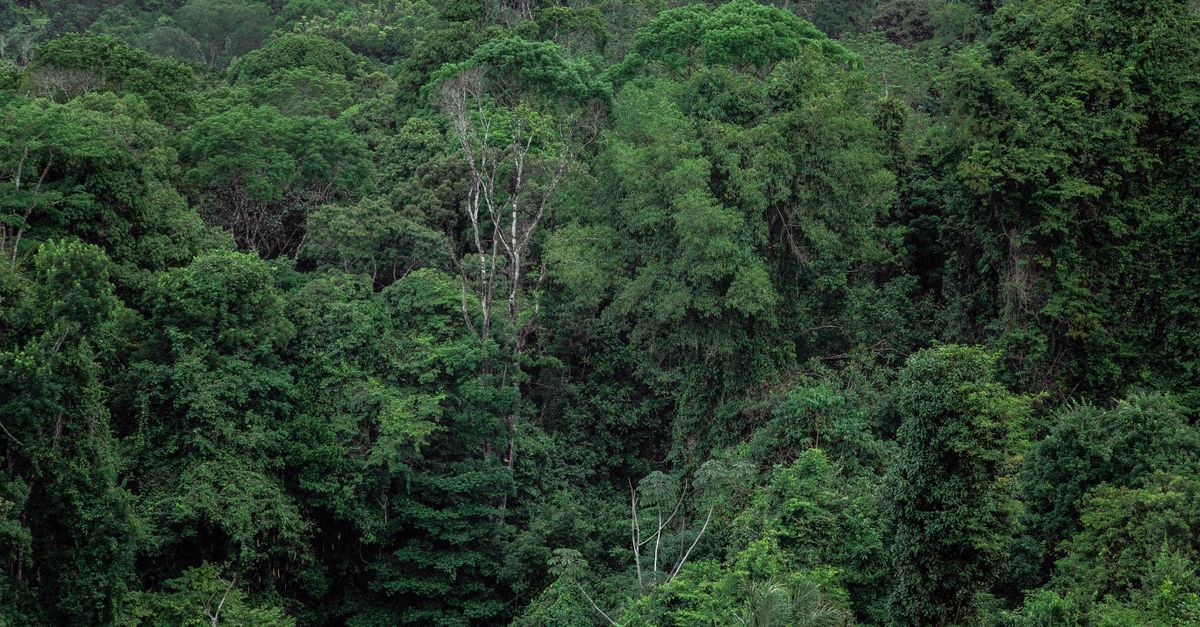
Tropical rainforests cover less than 10% of Earth's land surface, yet they are home to well over half of the planet's known plant and animal species by most ecological estimates. That concentration of life is not an accident — it is the direct result of a climate that almost never stops working: warm temperatures, abundant rainfall, and strong sunlight, every day of the year, with no winter to pause growth.
Understanding how a tropical rainforest ecosystem actually functions means looking past the postcard image of dense green canopy and asking where the nutrients come from, how the different layers of the forest interact, and why a biome this productive sits on some of the poorest soil on Earth. This article breaks down the structure, climate, food web, and conservation status of the tropical rainforest biome, using data from NASA Earth Observing System records and the IUCN Red List, each cited with the date we checked it.
Where tropical rainforests occur and why the climate matters
Tropical rainforests form in a band near the equator, mainly across the Amazon basin in South America, the Congo basin in Central Africa, and parts of Southeast Asia. The defining climate trait is consistency: temperatures stay hot and humid with little seasonal swing, and annual rainfall typically exceeds 2,000 mm, often falling in predictable afternoon downpours rather than long droughts. Because there is no cold season to slow metabolism and no dry season long enough to stress most plants, growth continues year-round — which is the single biggest reason this biome supports so much life.
Soil and nutrient cycling: a productive biome on poor ground
It surprises many people to learn that rainforest soils are often old, heavily weathered, and nutrient-poor. Millions of years of intense rainfall have leached minerals deep underground, and most of the ecosystem's nutrients are locked up in living biomass — the trees, vines, and animals themselves — rather than in the dirt. When a leaf or branch falls, decomposer fungi, termites, and bacteria break it down so quickly in the hot, humid conditions that nutrients are reabsorbed by shallow root systems almost before they reach the soil. This tight, fast nutrient loop is why intact rainforest can sustain extraordinary biomass despite thin topsoil — and why clearing it for farmland so often fails within a few growing seasons, once that stored biomass is removed.
The four layers of a rainforest
Rainforest structure is usually described in layers, from the emergent trees that poke above the main canopy, down through the dense canopy itself, into a dim understory, and finally the forest floor. Each layer has its own light levels, humidity, and resident species, which is part of why a single hectare of rainforest can contain hundreds of tree species — compared to a handful in a typical temperate forest of the same size.
| Layer | Typical height | Conditions |
|---|---|---|
| Emergent layer | 45–60 m+ | Full sun, wind exposure; scattered very tall trees |
| Canopy | 20–40 m | Dense, continuous leaf cover; most photosynthesis happens here |
| Understory | 5–20 m | Low light (as little as 2–5% of full sun reaches here) |
| Forest floor | 0–5 m | Dim, humid; dominated by decomposition and seedlings |
Typical flora and fauna
Rainforest plant life is built around capturing scarce light. Emergent canopy trees such as kapok tower above the rest; strangler figs and lianas (woody vines) climb existing trunks instead of building their own; and epiphytes like orchids and bromeliads grow directly on branches to reach sunlight without competing for ground space. Fauna is just as specialized: the jaguar (Panthera onca), the Americas' largest cat, is currently listed as Near Threatened with a decreasing population trend on the IUCN Red List (accessed November 4, 2026); orangutans (Pongo spp.) of Southeast Asia are Critically Endangered on the same list. Smaller but no less important residents include poison dart frogs, the harpy eagle, and leafcutter ants, which alone can move more soil than almost any other animal in the forest.
How the rainforest food web fits together
Producers — the canopy and understory trees, along with epiphytes — convert sunlight into the energy that supports a dense web of herbivores, from leaf-cutting insects to sloths and primates. Mid-level predators such as snakes and birds of prey feed on those herbivores, while apex predators like the jaguar and harpy eagle sit at the top. Decomposition, driven by fungi, bacteria, and termites, happens almost continuously because of the heat and humidity, cycling nutrients from dead material back into living plants within weeks rather than years.
How to recognize a healthy tropical rainforest
- Multiple distinct canopy layers, with little direct sunlight reaching the ground.
- A thin, fast-decomposing litter layer rather than deep accumulated leaf mold.
- High visible diversity of tree species and vine/epiphyte growth on trunks and branches.
- Year-round flowering and fruiting on at least some plant species, with no bare "winter" period.
- Presence of large, wide-ranging animals (big cats, primates, large birds of prey) as an indicator of an intact food web.
Threats and conservation status
Rainforest loss does not move in a straight line. Global Forest Watch, run by the World Resources Institute with the University of Maryland, recorded a record 6.7 million hectares of primary tropical forest loss in 2024 — the first year fire, rather than direct clearing, was the leading driver — before loss fell by about 36% in 2025 to roughly 4.3 million hectares. Even with that improvement, 2025's loss rate was still 46% higher than a decade earlier (accessed November 4, 2026). Because rainforest nutrients are stored in standing biomass rather than soil, cleared land often cannot sustain long-term farming, which drives a cycle of further clearing elsewhere.
Common mistakes
- Assuming rich soil. Rainforest soil is typically poor; the biome's productivity comes from fast nutrient cycling in living biomass, not fertile ground.
- Treating "rainforest" as one uniform place. Amazon, Congo, and Southeast Asian rainforests share a climate pattern but differ in species, history, and threats.
- Confusing tropical rainforest with tropical savanna. Savanna has a strong dry season and open grassland structure; rainforest does not. See our savanna ecosystem article for the comparison.
- Thinking deforestation trends only get worse. Rates fluctuate year to year with fire activity, policy, and economics — context matters more than a single year's headline number.
Frequently asked questions
Why do tropical rainforests have so little fertile soil?
Most rainforest nutrients are stored in living plants and the thin surface litter layer, not in the ground. Constant heat and moisture make decomposition so fast that nutrients are absorbed by roots and fungi almost as soon as they're released, leaving the underlying soil old, weathered, and nutrient-poor.
Which countries have the largest tropical rainforests?
Tropical rainforest occurs mainly across South America (the Amazon basin), Central Africa (the Congo basin), and Southeast Asia (Indonesia, Malaysia, and nearby islands).
Is deforestation getting better or worse?
Both, depending on the year. Global Forest Watch recorded a record 6.7 million hectares of primary tropical forest loss in 2024, driven largely by fire, before a roughly 36% drop to about 4.3 million hectares in 2025 — still 46% above the loss rate of a decade earlier, as of our November 4, 2026 consultation.
What animal best represents the tropical rainforest biome?
There's no single answer, but the jaguar is a widely used indicator species for Central and South American rainforest health, and is currently Near Threatened with a decreasing population trend on the IUCN Red List.
How is a tropical rainforest different from a temperate forest?
Tropical rainforests stay warm and wet year-round with no true winter, supporting year-round growth and far higher biodiversity, while temperate forests have four distinct seasons and generally lower species richness.
Sources
- NASA Earth Observing System Data (ORNL DAAC) — tropical forest net primary productivity. Accessed November 4, 2026. earthdata.nasa.gov
- IUCN Red List — Panthera onca (Jaguar). Accessed November 4, 2026. iucnredlist.org
- World Resources Institute / Global Forest Watch — tropical forest loss data. Accessed November 4, 2026. globalforestwatch.org