
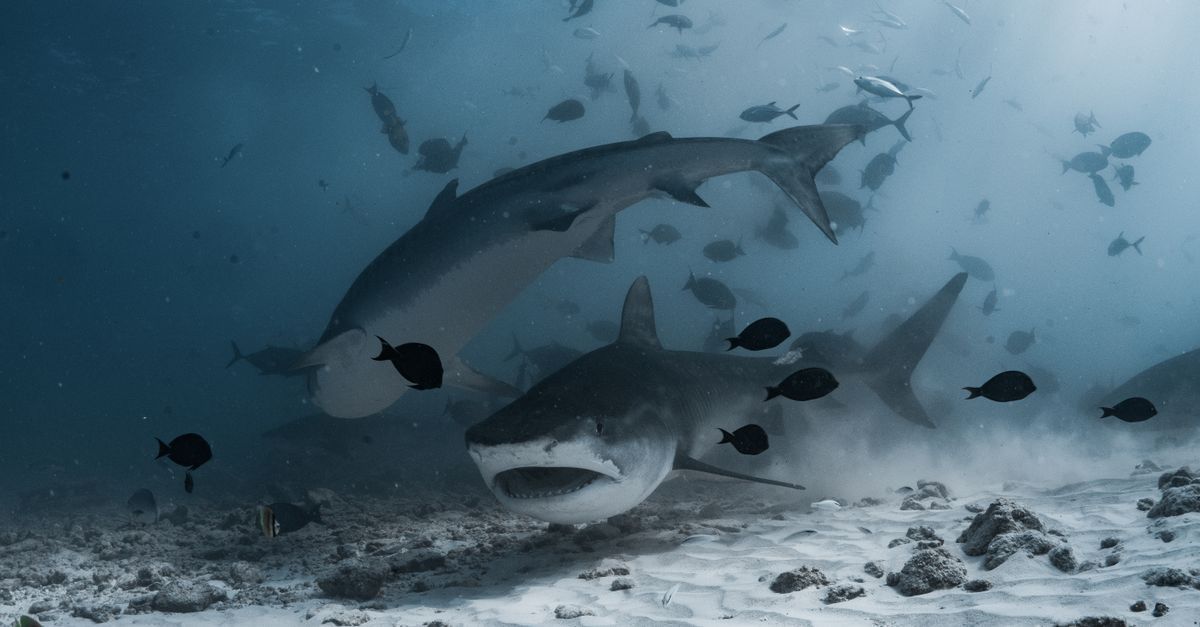
A blue whale, the largest animal that has ever lived, survives almost entirely on animals smaller than a grain of rice. That gap — between the ocean's smallest producers and its largest predators — is the story of the marine food web, a chain of energy transfer that starts with sunlight and microscopic algae and ends, a surprisingly small number of steps later, in some of the most powerful animals in the ocean.
The foundation: plankton
Marine food webs generally begin with plankton, organisms that drift with ocean currents rather than swimming against them. Phytoplankton — microscopic algae like diatoms and dinoflagellates — photosynthesize near the sunlit surface and form the producer base of nearly every marine food web, including the open ocean, coral reefs (via their coral-hosted algae), and coastal waters. Marine photosynthesis, driven mainly by phytoplankton, is estimated to produce roughly half of Earth's oxygen, according to NOAA's National Ocean Service, even though exact figures vary by source and ocean life also consumes a large share of that oxygen through respiration. Zooplankton — tiny drifting animals like copepods and krill — graze directly on phytoplankton and form the next link in the chain.
From plankton to predator: a simplified chain
| Step | Example | Role |
|---|---|---|
| 1 | Phytoplankton | Producer (photosynthesis) |
| 2 | Zooplankton (copepods, krill) | Primary consumer (grazer) |
| 3 | Small schooling fish (sardines, anchovies) | Secondary consumer |
| 4 | Tuna, sharks | Apex predator |
| Alternate path | Baleen whales | Filter-feed directly on krill, skipping several steps |
Why skipping steps is a winning strategy
Baleen whales, including blue whales, take a shortcut: instead of eating fish that ate zooplankton, they filter-feed on dense patches of krill directly, skipping several links in the chain. Each step in a food chain loses a significant portion of available energy as heat and metabolic waste, so an animal that feeds closer to the producer base can support a much larger body size on the same amount of ocean productivity — part of why filter-feeding whales can grow so much larger than predators that feed several steps further up the chain.
A daily link between the surface and the twilight zone
The marine food web isn't static across the day. Many zooplankton and small fish spend daylight hours in deeper, darker water to avoid sight-hunting predators, then rise toward the surface at night to feed on phytoplankton under cover of darkness — the same vertical migration pattern covered in our article on ocean zones. Because this migration happens on such a large scale, it effectively ferries energy and carbon between the sunlit surface and deeper water twice a day, connecting food webs that might otherwise look like separate systems.
Why so much energy disappears at each step
Ecologists have a rough rule of thumb for this loss, often called the ten percent rule, credited to ecologist Raymond Lindeman's 1942 work: on average, only about 10% of the energy stored at one trophic level gets converted into growth at the next level up, with actual efficiencies typically ranging from around 5% to 20% depending on the ecosystem. The rest is used for an animal's own metabolism, lost as heat, or never digested at all. Marine food webs tend to transfer energy somewhat more efficiently than land-based ones on average, but the same basic pattern holds: every step up a food chain supports far less total biomass than the step below it, which is part of why apex predators are naturally rare compared to the plankton at the base of the web.
The flip side: biomagnification
The same step-by-step structure that lets whales thrive on krill also concentrates pollution at the top of the food web. Through a process called biomagnification, substances like mercury that don't break down easily become more concentrated in each predator's tissue as it accumulates the pollutant load of everything it has eaten. Long-lived apex predators such as tuna and sharks, which sit at the top of a long food chain, often carry the highest pollutant concentrations in the entire ecosystem — a key reason health guidance sometimes limits how often people eat certain large predatory fish.
How different marine ecosystems build their food webs
- Coral reef: built on coral-hosted algae and coralline algae in a small, structured, three-dimensional space — see our coral reef ecosystem article.
- Open ocean: built on drifting phytoplankton spread across vast distances, often requiring predators to migrate long distances to find food.
- Kelp forest: built on fast-growing kelp anchored to rocky substrate, with a keystone predator (sea otters) regulating grazing pressure.
- Hydrothermal vent: an exception — built on chemosynthetic bacteria rather than sunlight-driven plankton at all.
Common mistakes about marine food webs
Common mistakes:
- Thinking the biggest animals must eat the biggest prey — the largest marine animals, baleen whales, actually eat some of the smallest.
- Assuming a marine "food chain" is a straight line — most ecosystems have overlapping food webs with multiple paths, not a single chain.
- Overlooking phytoplankton's importance because they're invisible to the naked eye — they underpin nearly the entire marine food web and a large share of the planet's oxygen production.
- Assuming pollutant exposure is evenly spread across an ecosystem — biomagnification means top predators carry a disproportionate share of the burden.
Frequently asked questions
What is the difference between phytoplankton and zooplankton?
Phytoplankton are microscopic algae that photosynthesize and form the base of most marine food webs. Zooplankton are tiny animals, including copepods and krill, that graze on phytoplankton and are themselves eaten by small fish.
How much of the world's oxygen comes from the ocean?
Marine photosynthesis, mainly by phytoplankton, is estimated to produce roughly half of Earth's oxygen, according to NOAA's National Ocean Service, though exact figures vary by source and method, and ocean life also consumes a large share of that oxygen through respiration.
Why do pollutants build up in top ocean predators?
Through a process called biomagnification, pollutants like mercury become more concentrated at each step up a food chain, since predators accumulate the pollutant load of everything they've eaten. This makes long-lived apex predators like tuna and sharks especially prone to high pollutant levels.
How does a coral reef food web differ from an open ocean food web?
A reef food web is built on fixed producers (coral's symbiotic algae and coralline algae) in a small, structured area, while an open ocean food web relies on drifting phytoplankton spread across vast, less structured distances, often requiring long migrations to find food.
Sources
- NOAA National Ocean Service — ocean oxygen production, accessed November 4, 2026. oceanservice.noaa.gov
- Lindeman, R. (1942) and subsequent ecological efficiency research — trophic transfer efficiency ("ten percent rule"), accessed November 4, 2026.