
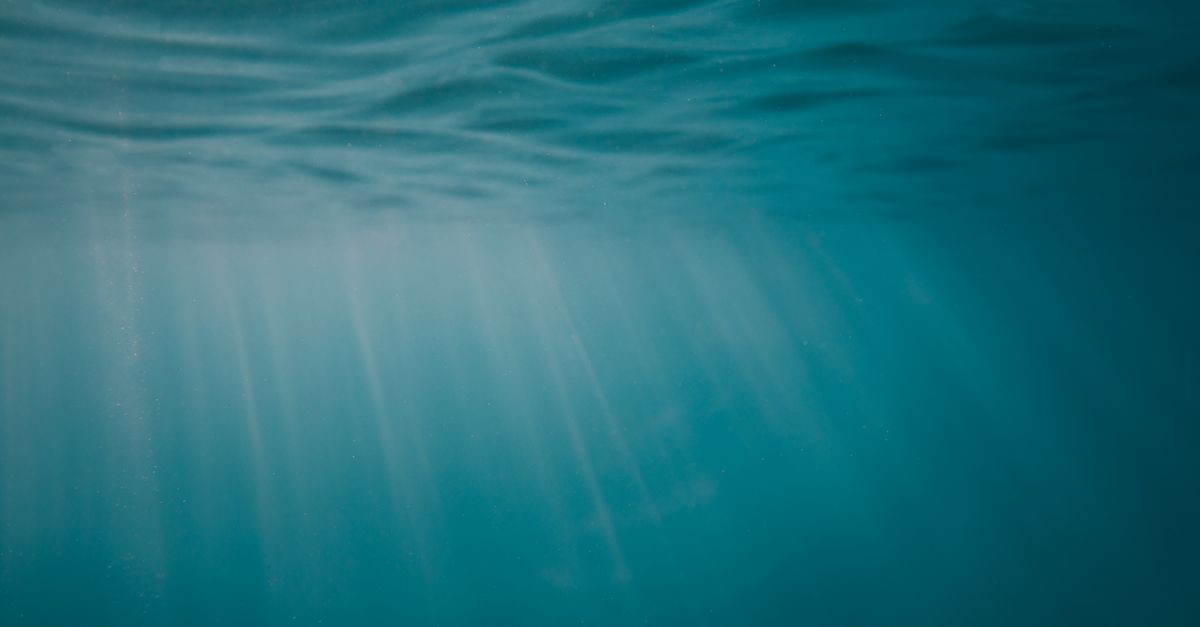
If you could descend straight down through the open ocean in a submersible, you would not pass through a single uniform environment. You would cross five broad zones, each defined by how much light penetrates that deep, and each hosting a different community of life adapted to its particular combination of light, temperature, and pressure.
Why depth, not distance from shore, defines these zones
Ocean zones are usually described by depth because light — not temperature or location — is the single biggest factor shaping what can live where. Sunlight that easily reaches a few meters down is almost completely absorbed or scattered by around 1,000 meters, regardless of where in the world you are. That's why the same five-zone structure applies from the tropics to the poles, even though the surface conditions above each zone vary enormously.
The five zones
| Zone | Approximate depth | Also known as | Conditions |
|---|---|---|---|
| Epipelagic | Surface–200 m | Sunlight zone | Enough light for photosynthesis; widest temperature range |
| Mesopelagic | 200–1,000 m | Twilight zone | Dim filtered light, not enough for photosynthesis; many vertical migrators |
| Bathypelagic | 1,000–4,000 m | Midnight zone | No sunlight at all; only bioluminescence; near-freezing water |
| Abyssopelagic | 4,000–6,000 m | Abyss | Crushing pressure, total darkness, sparse marine-snow-based food web |
| Hadalpelagic | Below 6,000 m | Hadal zone | Deep ocean trenches; extreme pressure; the Mariana Trench reaches about 10,911 m |
The twilight zone's daily commute
One of the most dramatic events in the ocean happens every day in the mesopelagic zone: the largest animal migration on Earth, measured by biomass. Enormous numbers of small fish, squid, and zooplankton rise from the twilight zone toward the surface each night to feed under cover of darkness, then descend again before dawn to avoid surface predators that hunt by sight. This daily vertical migration moves carbon and nutrients between zones and shapes food availability for predators at every depth along the way.
Just how much fish biomass makes that commute is still debated. Older trawl-based surveys put global mesopelagic fish biomass at roughly 1,000 million tons, a figure long used in ocean ecosystem models. A 2014 study in Nature Communications, using acoustic (sound-based) surveys from the Malaspina expedition, argued that nets undercount these fast, net-avoiding fish, and proposed the true figure could be several times higher — though the authors' own estimates range widely depending on the assumptions used, so the exact number remains an open scientific question rather than a settled fact.
Pressure and temperature across the zones
Depth changes more than light. Pressure increases by about one atmosphere for roughly every 10 meters of water, so an animal at the bottom of the Mariana Trench experiences pressure over 1,000 times that at the surface. Temperature follows a different pattern: the epipelagic zone can range from icy polar water to warm tropical water near 30°C, but by the bathypelagic zone and below, water temperature worldwide settles into a narrow band just above freezing, regardless of what's happening at the surface thousands of meters above. Organisms adapted to these deeper, colder, higher-pressure zones generally cannot survive a rapid trip to the surface, which is one reason deep-sea animals brought up in nets or submersibles are so rarely seen alive and intact once they reach the deck of a research vessel.
Bioluminescence: light the sun didn't provide
Below the epipelagic zone, where sunlight fades and then disappears entirely, a large share of animals make their own light instead. Researchers estimate that a majority of mesopelagic and bathypelagic species — including many fish, squid, and jellyfish — are bioluminescent, producing light through chemical reactions in specialized cells or light-producing bacteria they host. That light serves very different purposes depending on the species: some use flashing patterns to startle predators or to lure prey close, others use a faint glow on their undersides called counter-illumination to erase their silhouette against the faint light still filtering down from above, and some squid eject a cloud of glowing ink instead of the dark ink used by their shallow-water relatives, since dark ink would be useless as a decoy in a zone with no background light to hide against.
How each zone's residents are built for their depth
Body plans shift noticeably from zone to zone. Epipelagic predators like tuna are built for speed, with streamlined bodies suited to chasing prey through well-lit, oxygen-rich water. Mesopelagic fish, by contrast, often have large, light-gathering eyes to catch what little light remains, or no eyes at all if they rely entirely on other senses. Many bathypelagic and abyssopelagic fish — such as anglerfish — trade speed and eyesight for low-energy, ambush- style hunting, since food is scarce enough at that depth that chasing prey across long distances would burn more energy than it could possibly recover. These aren't separate design choices so much as the same evolutionary logic — conserve energy, exploit whatever light or food is available — expressed differently at each depth.
How zones connect to what we've already covered
- Coral reefs and kelp forests exist almost entirely within the epipelagic zone, where light supports photosynthesis.
- Most open-ocean (pelagic) fisheries, including tuna, operate in or move through the epipelagic and upper mesopelagic zones.
- The deep sea, as a general term, typically refers to the bathypelagic zone and below — see our dedicated article on deep sea ecosystems.
- Hydrothermal vents occur on the seafloor at a range of depths, often within the bathypelagic or abyssopelagic zones.
Common mistakes about ocean zones
Common mistakes:
- Treating the boundary depths as fixed, exact lines — they are approximate transitions that shift somewhat with water clarity and location.
- Assuming "deep sea" and "deep ocean zones" are interchangeable with a single zone — the term usually spans several zones below the sunlight layer.
- Thinking temperature drops smoothly with depth everywhere — hydrothermal vents create localized heat spikes that don't follow the general cooling trend.
- Assuming nothing changes at night — the mesopelagic zone empties and refills daily as animals migrate vertically to feed.
Frequently asked questions
What is the sunlight zone of the ocean called?
The sunlit surface layer, roughly from the surface to about 200 meters, is called the epipelagic zone. It's the only zone with enough light for photosynthesis.
What is the deepest ocean zone called?
The hadalpelagic (or hadopelagic) zone covers the deepest ocean trenches, generally below about 6,000 meters, down to the seafloor of features like the Mariana Trench, whose deepest point is roughly 10,911 meters.
Why is the twilight zone called that?
The mesopelagic, or twilight, zone (roughly 200 to 1,000 meters) receives a small amount of filtered sunlight, enough for some animals to see by but not enough to support photosynthesis.
Do ocean zone boundaries have exact depths?
No. The depths given for each zone are approximate and vary somewhat by water clarity, latitude, and the source consulted; they describe general transitions in light and temperature rather than sharp lines.
Sources
- NOAA / National Weather Service JetStream — ocean depth zone definitions, accessed November 4, 2026.
- University of Hawaiʻi, Exploring Our Fluid Earth — ocean depth zones, accessed November 4, 2026. manoa.hawaii.edu/exploringourfluidearth
- Irigoien et al., "Large mesopelagic fishes biomass and trophic efficiency in the open ocean," Nature Communications, 2014, accessed November 4, 2026. pmc.ncbi.nlm.nih.gov
- NOAA Ocean Exploration — bioluminescence overview, accessed November 4, 2026.