
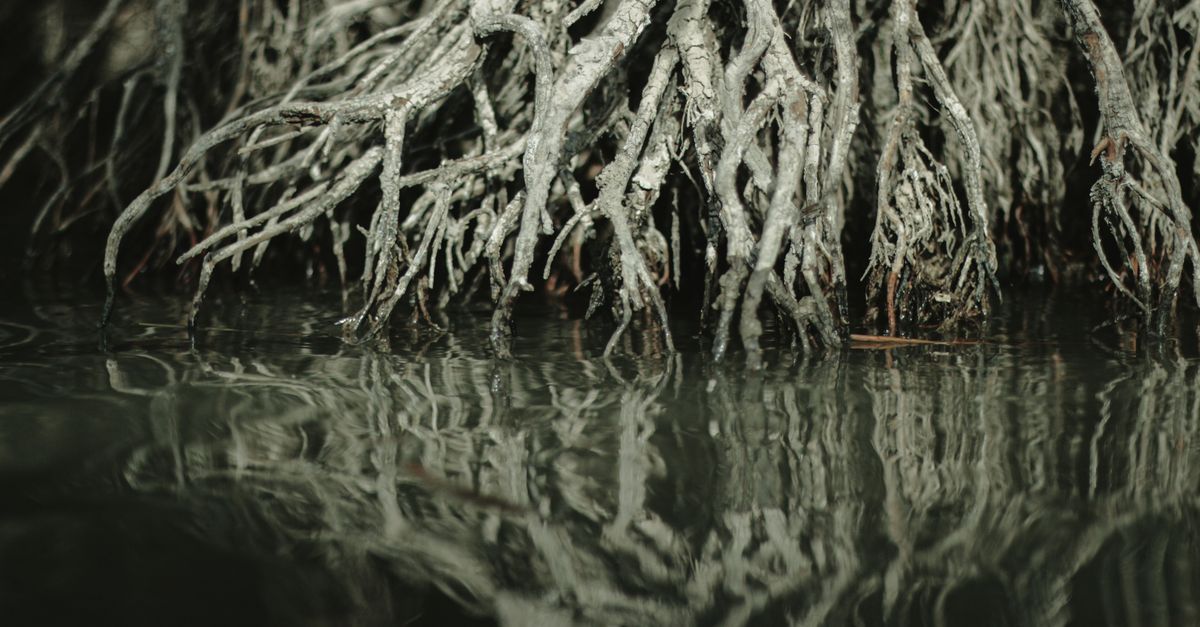
Mangrove forests grow where few other trees can survive: in salty, waterlogged, oxygen- poor mud, pounded by tides twice a day. This narrow strip between land and sea supports one of the most ecologically valuable ecosystems on Earth — a nursery for marine life, a buffer against storms, and a long-term carbon store, all in one.
Below, we cover how mangroves survive conditions that would kill most trees, why they matter so much to coastal food webs, and what's driving their loss worldwide.
Built for salt and mud: mangrove adaptations
Mangrove trees — including red, black, and white mangrove species — share a set of adaptations that let them thrive where land meets sea. Because the mud they grow in is waterlogged and low in oxygen, many species grow pneumatophores (specialized "breathing" roots) that poke up above the mud to take in air directly, or arching prop roots that both stabilize the tree and expose part of the root system to oxygen. To cope with saltwater, some species filter most salt out at the root, while others, like the black mangrove, actively excrete excess salt through glands on their leaves.
A critical nursery habitat
The dense, tangled mangrove root system does more than anchor the tree — it creates a sheltered maze that protects small fish and invertebrates from larger predators. Juvenile reef fish, shrimp, and crabs grow up among mangrove roots before many of them move out to coral reefs or open water as adults. This makes mangroves a foundational nursery habitat linking land-based ecosystems to wider marine food webs, including the coral reefs many visitors associate with tropical coasts.
Where mangroves grow
Mangroves only grow along tropical and subtropical coastlines, roughly between 30°N and 30°S, where winters stay mild enough that hard frost doesn't kill the trees. According to the FAO's "World's Mangroves 2000–2020" assessment, the global mangrove area totaled about 14.8 million hectares in 2020, and it is concentrated in a small number of countries: Indonesia alone holds about 19% of the world's mangrove area, with Brazil, Nigeria, and Mexico each holding roughly 6–9%. Together, just five countries — Indonesia, Brazil, Nigeria, Mexico, and Australia — account for close to half of all mangrove forest on Earth, which is one reason mangrove policy in those countries has an outsized effect on the global total.
From leaf litter to the coastal food web
Mangrove leaf litter decomposes into fine detritus that fuels crabs, shrimp, and filter feeders directly in the mangrove forest. Predators such as mudskippers, saltwater crocodiles, and wading birds like the roseate spoonbill feed within this system, while much of the mangrove's organic production is exported by tides into adjacent estuaries and coastal waters, supporting food webs well beyond the forest itself.
| Period | Approximate annual loss |
|---|---|
| 2000–2010 | ~18,200 hectares per year |
| 2010–2020 | ~10,200 hectares per year |
| 1990–2020 (cumulative) | ~1.04 million hectares lost overall |
Blue carbon: why mangrove soil matters for climate
Mangroves are also valued for something invisible from the surface: the carbon locked away in their waterlogged soil. Unlike a typical forest, where most stored carbon sits in wood and leaves, mangroves bury a large share of their carbon in flooded, low-oxygen mud that slows decomposition dramatically, allowing organic material to accumulate over centuries instead of breaking down and releasing carbon back into the atmosphere. Scientists call this "blue carbon," a term that also applies to seagrass meadows and salt marshes, and research summarized by UNEP and partner institutions has found that, per hectare, mangrove ecosystems can store several times more carbon than many upland tropical forests, mostly below ground rather than in the trees themselves. That makes mangrove loss a double cost: it removes the living ecosystem and risks releasing carbon that had been locked in the soil for a long time, which is one reason mangrove conservation increasingly features in international climate strategies alongside its more visible benefits for fisheries and coastal protection.
Why mangroves are disappearing
According to the FAO's assessment of mangrove area from 2000 to 2020, the leading driver of mangrove loss is conversion for aquaculture — particularly shrimp ponds — alongside coastal development and agricultural expansion. The encouraging part of that same data is that the annual rate of loss has slowed substantially, roughly halving between the 2000s and the 2010s, which researchers attribute partly to stronger mangrove protection and restoration efforts in several countries.
Quick example: a shrimp pond conversion
A coastal community clears a stretch of mangrove forest to build shrimp aquaculture ponds. In the short term, this creates economic value, but it also removes the nursery habitat that supported the juvenile fish stocks many local fishers depended on, along with the natural buffer that protected the coastline from storm surge — trade-offs that conservation and sustainable aquaculture programs try to balance.
Common mistakes
- Thinking all mangroves are the same species: red, black, and white mangroves have different root structures and salt tolerance.
- Underestimating their role beyond the forest: mangrove productivity supports food webs well beyond their own boundaries, including reef fish populations.
- Assuming mangrove loss has stopped: the rate has slowed, but mangrove area is still declining overall.
- Overlooking restoration difficulty: young, replanted mangroves generally provide far less storm protection than mature forests until they establish.
FAQ
Why do mangrove roots stick up out of the mud?
Mangrove mud is waterlogged and low in oxygen, so many mangrove species grow specialized above-ground roots called pneumatophores, or arching prop roots, that take in oxygen directly from the air.
How do mangroves survive in salt water?
Different mangrove species cope with salt in different ways: some filter most salt out at the root, while others, like the black mangrove, excrete excess salt through glands on their leaves.
Why are mangroves called a nursery habitat?
The tangled root systems of mangroves provide shelter from predators for juvenile fish and invertebrates, many of which later move out to coral reefs or open water as adults, linking mangrove forests to wider marine food webs.
How fast is mangrove area declining?
According to the FAO's 2000–2020 global assessment, mangrove area fell by about 1.04 million hectares between 1990 and 2020, though the annual rate of loss has slowed, from about 18,200 hectares a year in 2000–2010 to about 10,200 hectares a year in 2010–2020.
What is the main driver of mangrove loss?
The FAO identifies conversion for aquaculture, especially shrimp ponds, as the leading driver of mangrove loss globally, alongside coastal development and agriculture.
Sources
- FAO — The World's Mangroves 2000–2020, accessed November 4, 2026.
- UNEP — Blue carbon and mangrove ecosystem services overview, accessed November 4, 2026.