
When a storm surge approaches a coastline, what stands between the open sea and the community behind it can make a measurable difference. In many tropical and subtropical regions, that buffer is a mangrove forest — and the research on how much protection it actually provides is more specific than most people expect.
This article looks at what large-scale modeling and field studies show about mangrove wave attenuation, why forest width is such a strong predictor of protection, and where the limits of that protection are.
What a global modeling study found
A large-scale modeling effort covering more than 15,000 mangrove locations worldwide ran tens of thousands of simulations to estimate how much wave energy different mangrove forests absorb. The headline result: for forests wider than 500 metres — representing about 46% of the world's coastal mangroves — roughly 75% or more of incoming wave energy was reduced before reaching the shoreline behind them, largely regardless of local conditions.
Why width matters more than almost anything else
Narrower mangrove belts, under 500 metres wide, showed much more variable results, depending heavily on local water levels, wave characteristics, and how dense the forest was. In practice, this means a thin fringe of mangroves at the water's edge offers real but inconsistent protection, while a wide, intact mangrove forest offers protection that's both larger and more predictable.
| Location / study | Finding |
|---|---|
| Global model (>500 m wide forests) | ~75% or more of wave energy reduced |
| Bac Lieu, Vietnam | Wave reduction over 100 m inland rose from 32% to 91%; 80%+ reduction after ~76 m of forest |
| Tong King delta, Vietnam | ~20% wave reduction per 100 m in mature forest; little effect in young reforestation |
| Indonesia (Avicennia marina) | Attenuation ranged from 50% to 92% depending on forest thickness |
Mature forest versus young reforestation
Field research consistently shows a gap between mature, established mangrove stands and newly replanted ones. In Vietnam's Tong King delta, for example, mature forest reduced wave energy measurably per 100 metres of width, while young reforested areas showed little protective effect until the trees grew and the root system matured. This matters for coastal planning: restoring mangroves is a sound long-term investment, but it isn't an immediate substitute for mature forest that's been cleared.
What this protection is worth in economic terms
Wave attenuation translates into real avoided damage. A 2020 study published in Scientific Reports, which paired hydrodynamic flood models with economic analysis across the world's mangrove coastlines, estimated that mangroves provide flood protection benefits worth more than $65 billion a year, and that losing them would leave roughly 15 million more people exposed to flooding annually. The benefits are not spread evenly: the study found the largest absolute economic value concentrated along coastlines in the United States, China, and Taiwan, while Vietnam, India, and Bangladesh have the greatest number of people protected. More than 45 stretches of coastline near cities each receive over $250 million a year in flood protection value from nearby mangroves, according to the same analysis.
The physical mechanism: how roots slow moving water
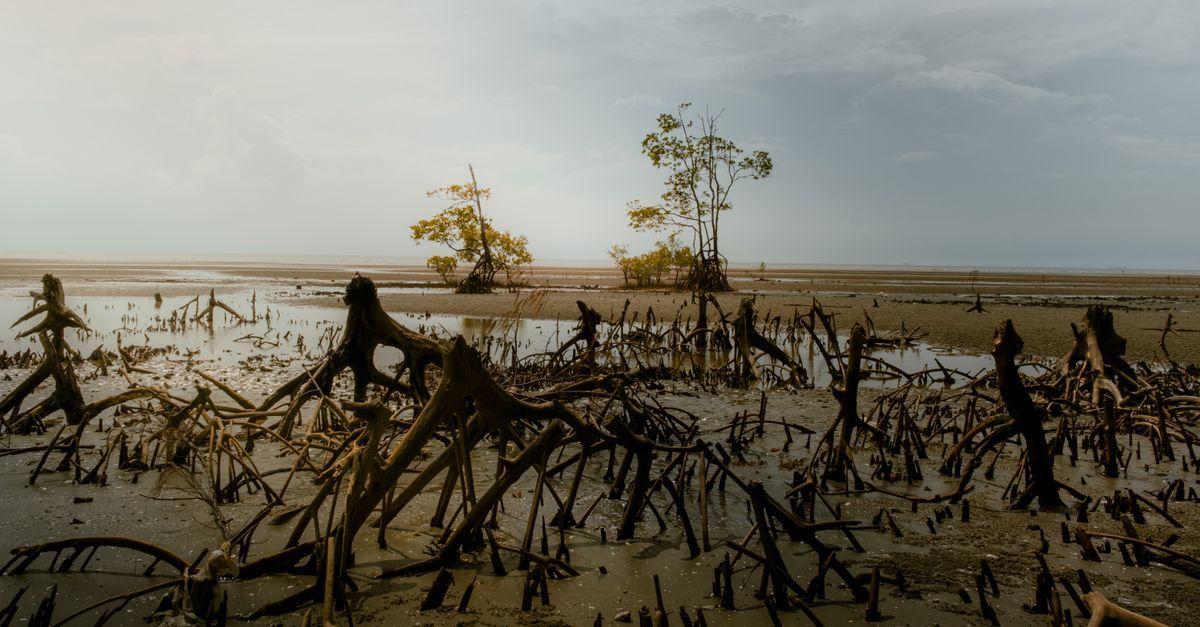
The protection isn't magic — it comes down to physical drag. A mangrove's dense tangle of prop roots and pneumatophores, described in our mangrove ecosystem overview, creates enormous surface area close to the water line. As a wave or surge pushes through that root structure, friction between the water and thousands of individual roots per square metre converts some of the water's kinetic energy into turbulence and heat rather than letting it travel forward unimpeded. Trunks and low branches add a second layer of resistance higher up the water column during larger surges. This is the same basic principle used by engineered wave breaks, but a living root system also traps sediment as water slows, gradually building up the muddy substrate the forest grows in — meaning a healthy mangrove forest can, over time, help raise the land behind it rather than simply blocking waves passively.
Mangroves alongside, not instead of, engineered defenses
Mangrove protection doesn't fully replace seawalls or levees in high-risk areas, but it can reduce the wave energy that engineered defenses need to absorb, often at a fraction of the construction and maintenance cost of hard infrastructure alone. This is why an increasing number of coastal protection plans combine mangrove conservation or restoration with built defenses rather than choosing one approach exclusively.
Quick example: comparing two coastlines
Two otherwise similar coastal towns face the same storm. One sits behind 600 metres of mature mangrove forest; the other has had its mangroves cleared for development. Based on the modeling research above, the first town can expect the mangrove belt to absorb roughly three-quarters or more of the incoming wave energy before it reaches engineered defenses or the shoreline itself — a buffer the second town does not have.
Common mistakes
- Assuming any mangrove fringe provides strong protection: narrow belts under 500 metres are far less predictable than wide, mature forests.
- Expecting instant protection from newly planted mangroves: young reforestation offers limited wave reduction until trees mature.
- Treating mangroves as a total replacement for engineered defenses: they reduce wave energy but don't eliminate storm risk entirely.
- Overlooking maintenance: mangrove protection depends on keeping the forest healthy and intact, not just planting it once.
FAQ
How much wave energy can a mangrove forest absorb?
A global modeling study covering more than 15,000 mangrove locations found that forests wider than 500 metres, about 46% of the world's coastal mangroves, reduced incoming wave energy by roughly 75% or more.
Does mangrove width matter more than density?
Both matter, but width is especially influential: narrower mangrove belts (under 500 metres) depend much more on local conditions like water level, wave size, and tree density, while wide forests consistently absorb a large share of wave energy.
Can young, replanted mangroves protect a coastline as well as mature forest?
Not immediately. Field studies, including work in Vietnam's Tong King delta, found that mature mangrove stands reduced wave energy substantially per 100 metres of forest, while young reforested areas had little measurable effect until the trees matured.
Do mangroves replace the need for seawalls?
Not entirely, but they can reduce the wave energy a seawall or levee needs to withstand, often at lower cost than built infrastructure alone, which is why many coastal protection plans now combine mangrove restoration with engineered defenses.
What other benefits do mangroves provide alongside storm protection?
Beyond reducing wave energy, mangroves serve as a nursery habitat for fish and invertebrates, filter land-based runoff before it reaches the sea, and store carbon in their root systems and waterlogged soil.
Sources
- PreventionWeb — How do mangroves contribute to flood risk management (summarizing global mangrove wave-attenuation modeling), accessed November 4, 2026.
- Mangroves as coastal protection from waves in the Tong King delta, Vietnam, accessed November 4, 2026.
- FAO — The World's Mangroves 2000–2020, accessed November 4, 2026.
- Menéndez et al. (2020), Scientific Reports — The Global Flood Protection Benefits of Mangroves, accessed November 4, 2026.