
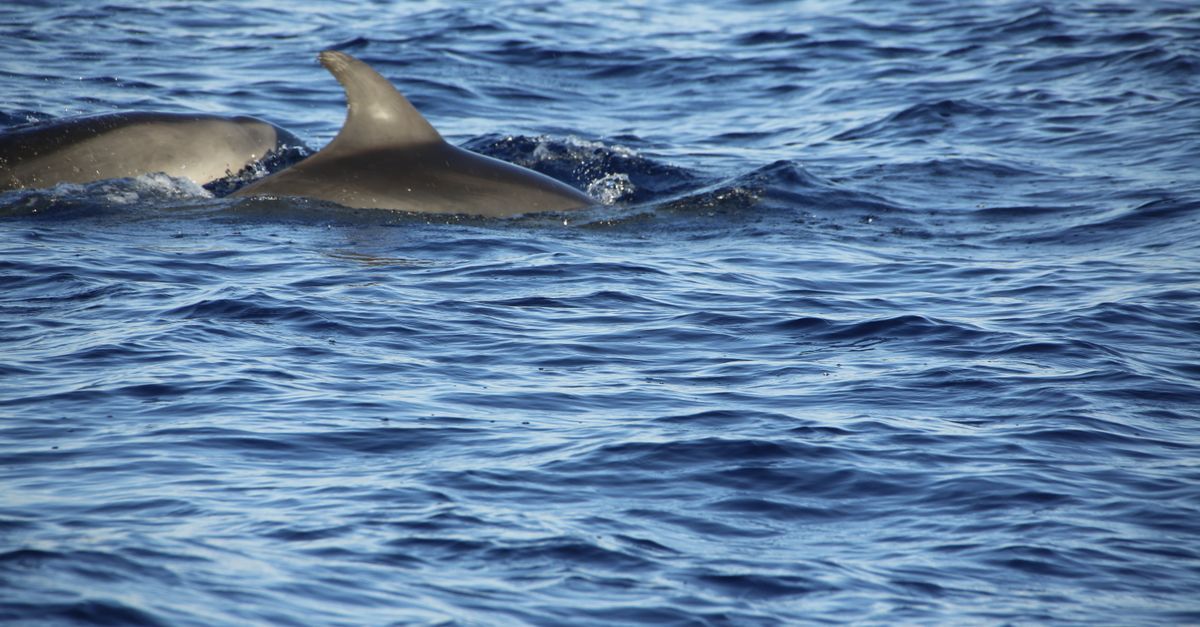
Most people picture the ocean as the coastline they've visited: a beach, a reef, a tide pool. But the vast majority of the ocean isn't near any coast at all. The open ocean, or pelagic zone, is the water column far from shore and far from the seafloor — an ecosystem defined not by a solid habitat but by water itself, currents, and the sunlight that penetrates only its uppermost layer.
An ecosystem with no fixed address
Unlike a forest or a reef, the open ocean has no substrate to anchor to and no fixed boundary that organisms can rely on for shelter. "Pelagic" simply means open water, as opposed to "benthic" (seafloor-associated) or coastal/neritic (over the continental shelf). The open ocean spans every latitude and virtually every temperature range found on Earth; it is water temperature and nutrient availability, not air climate, that structure life within it.
Why most of the open ocean is a biological desert — except where it isn't
Away from coastal upwelling zones, the open ocean is often called a biological desert: nutrients that fuel photosynthesis are scarce in the sunlit surface layer, because dead organic matter tends to sink faster than it can be recycled back up. Net primary productivity in these nutrient-poor open waters is commonly estimated at roughly 50–120 grams of carbon per square meter per year — far below a tropical rainforest or a coral reef. But because the open ocean covers about 90% of the ocean's surface, even that modest per-area productivity adds up to a very large share of the planet's total marine primary production. Narrow upwelling zones, where deep nutrient-rich water rises to the surface, can be dramatically more productive and attract concentrated marine life.
The food web: a long chain that concentrates energy at the top
Phytoplankton — microscopic algae like diatoms and dinoflagellates — are the open ocean's primary producers. Zooplankton, including copepods and krill, graze on phytoplankton and are themselves eaten by small schooling fish. Those fish support progressively larger predators: tuna, oceanic whitetip sharks, sea turtles, and the largest animals on Earth, baleen whales, which filter-feed on dense plankton patches. Because this chain has many links, energy — and unfortunately pollutants such as mercury and persistent plastics — tends to concentrate at the top of the food web, in long-lived predators like tuna and sharks.
| Level | Examples |
|---|---|
| Producers | Phytoplankton (diatoms, dinoflagellates), floating Sargassum algae |
| Primary consumers | Zooplankton (copepods, krill) |
| Secondary consumers | Small schooling fish (sardines, anchovies) |
| Apex predators | Tuna, oceanic whitetip shark, blue whale (filter-feeding) |
Adaptations for a life with nowhere to hide
- Streamlined, muscular bodies built for sustained long-distance swimming, since there's no structure to hide behind
- Countershading — dark coloring on top, pale underneath — to blend in when viewed from above or below
- Filter-feeding in the largest animals (baleen whales) to exploit dense but scattered plankton patches efficiently
- Buoyancy control through gas bladders or oil storage, since sinking or floating uncontrollably wastes energy over huge distances
A practical example: why tuna travel so far
Many open-ocean predators, including tuna, are highly migratory, crossing entire ocean basins over a lifetime. That's a direct consequence of pelagic productivity being patchy and seasonal: a predator that stayed in one place would face long stretches with little food. Following productive zones — upwelling areas, current boundaries, seasonal plankton blooms — is an energy-efficient strategy in an ecosystem where food is unevenly distributed across enormous distances.
Common mistakes about the open ocean
Common mistakes:
- Assuming the open ocean is mostly empty — it is productive per unit of effort for animals adapted to cover huge distances, even though it is less dense with life than a reef or kelp forest.
- Confusing the pelagic zone with the deep sea — pelagic refers to the open water column at any depth, including sunlit surface waters, while "deep sea" specifically refers to the dark depths below the sunlight zone.
- Thinking open ocean life is unaffected by what happens near shore — plastic pollution and nutrient runoff from land travel far into open-ocean currents and gyres.
- Treating the whole open ocean as uniformly unproductive — upwelling zones within it can rival coastal waters in productivity.
Frequently asked questions
What does "pelagic" mean?
Pelagic refers to the open water column of the ocean, away from the seafloor and away from the coast, as opposed to benthic (seafloor) or coastal/neritic zones.
Is the open ocean more or less productive than coastal water?
Per square meter, most of the open ocean is far less productive than coastal upwelling zones, since nutrients are scarce away from the coast and the seafloor. But because the open ocean covers roughly 90% of the ocean's surface, it still accounts for a very large share of total marine primary production.
What is phytoplankton's role in the open ocean?
Phytoplankton are the open ocean's primary producers, converting sunlight into food through photosynthesis near the surface. They form the base of the pelagic food web and are a major contributor to the ocean's oxygen production, alongside marine plants and other algae.
How much of the seafloor beneath the open ocean has been mapped?
As of 2026, NOAA-linked global mapping initiatives put high-resolution seafloor mapping coverage at roughly a quarter to just under 30% of the globe, meaning most of the deep ocean beneath the open ocean's surface waters remains poorly studied.
Sources
- NOAA Ocean Exploration — global seafloor mapping progress, accessed November 4, 2026. oceanexplorer.noaa.gov
- NOAA National Ocean Service — ocean primary production and oxygen, accessed November 4, 2026. oceanservice.noaa.gov