
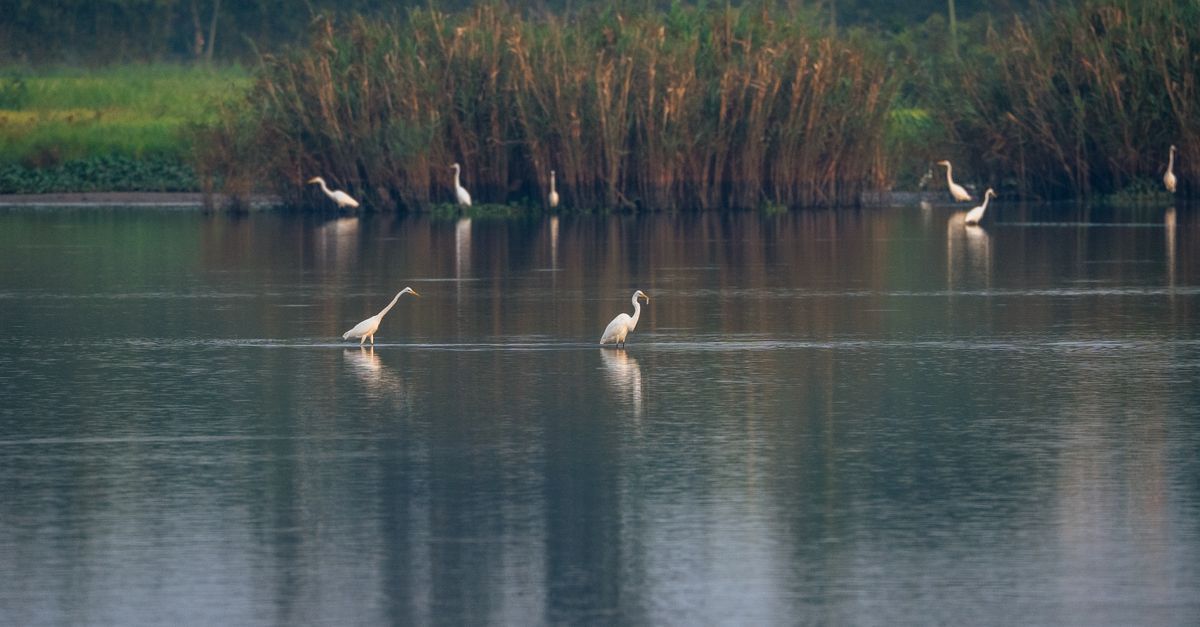
A marsh can look deceptively calm on the surface — a stand of reeds, some open water, a heron standing motionless at the edge. Underneath that stillness is one of the most densely packed food webs of any ecosystem, built on the exceptional productivity of wetland plants.
This article traces that food web step by step, from the producers at the base to the predators and decomposers that complete the cycle.
The producers: plants and algae
Emergent plants such as cattails and reeds (Phragmites) form the structural backbone of a marsh, while sedges, duckweed, water lilies, and algae growing on submerged surfaces add further plant production. Because wetlands combine abundant water, nutrients, and direct sunlight, these producers grow extremely fast, generating far more plant material per unit area than most other ecosystems.
The primary consumers: invertebrates
A huge population of invertebrates — dragonfly and damselfly larvae, aquatic beetles, snails, and worms — feeds directly on this plant material, algae, and decaying organic matter. This invertebrate layer is the crucial link between plant production and the larger animals above it, and its sheer abundance is a major reason marshes can support so much wildlife in a small area.
Mid-level consumers: amphibians and fish
Amphibians such as the American bullfrog, along with small fish, feed heavily on wetland invertebrates. Many of these species have life cycles tied closely to the wetland itself — frogs, for instance, spend their larval stage entirely in the water before transitioning to a partly terrestrial adult life, making them sensitive indicators of wetland water quality.
Why there are so many more plants than predators
One reason a marsh has vastly more plant material than herons is a basic rule of ecological energy transfer: each time energy moves from one feeding level to the next, most of it is lost as heat through metabolism rather than passed on as new body mass. Ecologists commonly use roughly 10% as a rule-of-thumb estimate for how much energy survives the jump from one trophic level to the next, though the real figure varies by ecosystem and species. In practical terms, that means it takes a large base of plant production to support a much smaller mass of invertebrates, a smaller mass of fish and frogs feeding on those invertebrates, and fewer herons and muskrat still at the top — which is exactly the plant-heavy, predator-light pattern a healthy marsh shows.
Top consumers: birds and mammals
Wading birds like herons and egrets, along with mammals such as muskrat, sit near the top of the wetland food web. Herons and egrets use long legs and specialized bills to hunt fish, amphibians, and invertebrates in shallow water, while muskrat feed on wetland vegetation and, opportunistically, on small animals — illustrating how wetland food webs branch rather than form a single straight chain.
| Level | Examples | Feeds on |
|---|---|---|
| Producers | Cattails, reeds, duckweed, algae | Sunlight, water, nutrients |
| Primary consumers | Dragonfly larvae, snails, aquatic beetles | Plants, algae, detritus |
| Mid-level consumers | American bullfrog, small fish | Invertebrates |
| Top consumers | Herons, egrets, muskrat | Fish, amphibians, invertebrates, plants |
| Decomposers | Bacteria, fungi in waterlogged soil | Dead plant and animal matter |
Decomposers and the slow nutrient cycle
Because wetland soil is waterlogged and oxygen-poor, decomposition happens more slowly than in a well-drained forest soil. Bacteria and fungi still break down dead organic matter and recycle nutrients, but the slow pace allows some material to accumulate as peat rather than fully decomposing — linking the wetland food web directly to the ecosystem's role as a long-term carbon store.
Two food webs in one: grazing vs. detrital pathways
Ecologists often split a wetland's energy flow into two overlapping pathways. The "grazing" food web is the one most people picture first: living plants are eaten directly by invertebrates, which are eaten by fish and frogs, and so on up to herons and muskrat. The "detrital" food web runs in parallel and, in many marshes, actually moves more energy overall — it starts when plant material dies and is broken down by bacteria and fungi into detritus, which is then consumed by specialized detritivores such as certain worms, amphipods, and aquatic insect larvae. Those detritivores are, in turn, eaten by many of the same fish and birds that also feed on the grazing pathway, meaning a heron hunting in a marsh may be drawing energy that originally passed through dead, decomposing cattail leaves just as often as through a leaf a snail ate while it was still alive. Recognizing both pathways helps explain why wetlands can support so much animal life relative to their size: very little of the enormous plant production goes to waste, whether it is eaten fresh or after it dies.
Quick example: a frog population as an indicator
Because amphibians like the American bullfrog have permeable skin and a life cycle split between water and land, a decline in their population within a marsh often signals a water quality problem — such as pollution or reduced oxygen — before the change becomes obvious in other parts of the food web.
Common mistakes
- Drawing the food web as a straight line: real wetland food webs branch, with many species feeding at more than one level.
- Forgetting decomposers: they're not a side note — they recycle the nutrients the entire system depends on.
- Assuming all wetland birds eat the same prey: different wading bird species specialize in different depths and prey sizes.
- Overlooking invertebrates: they're less visible than birds or frogs but represent the largest biomass link in the chain.
FAQ
What are the producers in a wetland food web?
Emergent plants such as cattails and reeds, along with algae and floating plants like duckweed, are the main producers in a freshwater wetland, converting sunlight into the energy that supports the rest of the food web.
What role do invertebrates play in a marsh?
Invertebrates such as dragonfly larvae and aquatic insects are a crucial middle layer, feeding on algae, plant material, and smaller organisms while serving as the primary food source for amphibians and fish.
Why are wading birds often top predators in wetlands?
Wading birds such as herons and egrets have long legs and specialized bills adapted for hunting fish, amphibians, and invertebrates in shallow water, placing them near the top of many wetland food webs.
What is the role of decomposers in a wetland?
Decomposers break down dead plant and animal material in the waterlogged soil, recycling nutrients back into the system, though this process happens slowly due to low oxygen levels, which allows some organic matter to accumulate as peat.
Can a single species appear at multiple levels of a wetland food web?
Yes. Many wetland animals, including some fish and amphibians, change their diet as they grow, starting as invertebrate-eaters and shifting toward larger prey, which means food webs are rarely as linear as simplified diagrams suggest.
Sources
- Ramsar Convention — Global Wetland Outlook 2025, accessed November 4, 2026.