
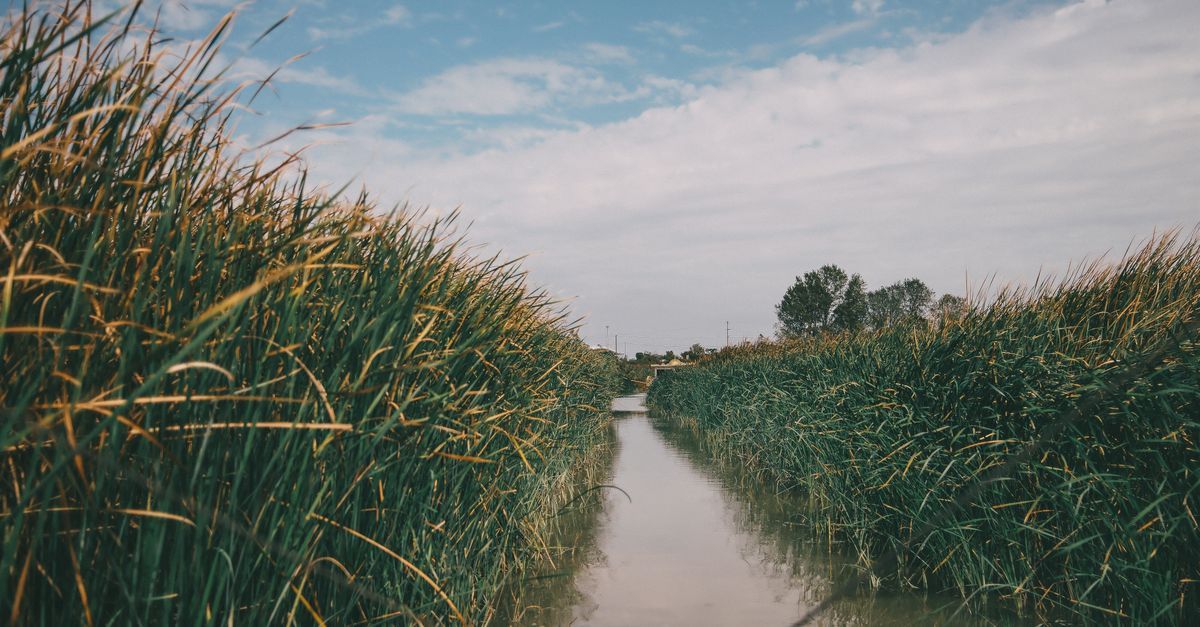
Freshwater wetlands — marshes, swamps, and similar waterlogged habitats — are often dismissed as unused or unproductive land. In reality, they're among the most biologically productive ecosystems on the planet, and they perform a service that's hard to replace with engineering: filtering water naturally as it moves through the landscape.
This article explains what defines a freshwater wetland, why it's so productive, how its natural filtration works, and what's putting these ecosystems at risk worldwide.
What defines a freshwater wetland
A wetland is defined less by depth than by saturation: soil that is waterlogged permanently or seasonally, with low oxygen levels, supporting plants specially adapted to those conditions. Typical freshwater wetland plants include cattails, reeds (Phragmites), sedges, duckweed, and water lilies — species with tissue adaptations that let their roots survive in oxygen-poor mud.
Marsh, swamp, bog, or fen? The main wetland types
"Wetland" is an umbrella term that covers several distinct habitat types, and the differences matter for the plants and animals each one supports. The Ramsar Convention, the main international treaty on wetland conservation, classifies inland wetlands into categories that map roughly onto these everyday terms:
- Marshes are dominated by soft-stemmed, non-woody plants such as cattails, reeds, and sedges, growing in mineral-rich soil that is seasonally or permanently flooded with shallow water.
- Swamps are wetlands dominated by woody vegetation — trees or shrubs — such as the bald cypress swamps of the southeastern United States, with standing water around the tree bases for at least part of the year.
- Bogs are fed mainly by rainfall rather than groundwater or rivers, which makes them acidic and nutrient-poor; they're typically covered in peat-forming sphagnum moss.
- Fens look similar to bogs but are fed by groundwater, which makes them less acidic and more nutrient-rich, supporting a greater diversity of plant life than a typical bog.
A single large wetland complex can contain more than one of these types side by side, which is one reason wetland boundaries and classifications can be more complicated than they first appear.
Why wetlands are so productive
Freshwater wetlands combine three ingredients that drive high biological productivity: abundant water, high nutrient availability, and direct sunlight reaching emergent vegetation (unlike a forest canopy that shades the ground). That combination lets wetland plants grow and reproduce rapidly, supporting dense populations of invertebrates, amphibians, fish, and birds — often rivaling or exceeding the productivity of agricultural land, without any human input.
How wetlands filter water naturally
When water carrying sediment, excess nutrients, or pollutants flows into a wetland, the dense stems of emergent plants slow the current dramatically. That slower flow lets suspended sediment settle out, while plant roots and soil microbes take up dissolved nutrients like nitrogen and phosphorus before the water continues downstream. This is why wetlands are often described as nature's water filters, and why constructed wetlands are sometimes built deliberately to treat agricultural or urban runoff.
| Pollutant type | How the wetland handles it |
|---|---|
| Suspended sediment | Slowed water flow around dense plant stems allows particles to settle to the bottom |
| Excess nitrogen | Taken up by plant roots and processed by soil microbes, including through denitrification |
| Excess phosphorus | Bound to wetland soils and taken up by plants and algae |
| Some pathogens | Reduced through settling, filtration, and exposure to sunlight (UV) in shallow water |
A long-term carbon store
Because wetland soils are waterlogged and low in oxygen, decomposition happens slowly. Instead of breaking down quickly and releasing carbon dioxide, dead plant material can accumulate over centuries as peat, locking carbon away. This makes healthy wetlands an important long-term carbon store — and makes draining or burning them a significant source of greenhouse gas emissions.
Checklist: how to recognize a healthy freshwater wetland
- Standing or seasonally fluctuating water with waterlogged, often dark, organic-rich soil.
- Dense stands of emergent vegetation such as cattails, reeds, or sedges.
- Visible wildlife activity — wading birds, dragonflies, frog calls, or muskrat trails.
- Relatively clear water exiting the wetland compared with the water entering it.
- Connection to a larger water body (a lake, river, or groundwater system) rather than complete isolation.
Common mistakes
- Calling all wetlands "swamps": marshes, swamps, bogs, and fens are distinct wetland types with different vegetation and water chemistry.
- Assuming wetlands are wasted or unproductive land: they're among the most productive ecosystems per unit area on Earth.
- Overlooking their role in flood control: wetlands absorb and slow floodwater, reducing downstream flood peaks.
- Thinking drainage has no downstream cost: draining a wetland removes its filtering capacity, often increasing pollution and flooding elsewhere.
FAQ
What makes a wetland different from a lake or a flooded field?
A wetland is defined by waterlogged, often oxygen-poor soil and plants adapted to grow in standing or seasonal water, such as cattails and reeds, rather than by a fixed depth or permanent open water like a lake.
Why are wetlands called nature's water filters?
Dense wetland vegetation and waterlogged soils slow down water flow and trap sediment and excess nutrients, allowing microbes and plants to take up pollutants before the water reaches a lake, river, or aquifer.
How much of the world's wetlands have been lost?
The Ramsar Convention's Global Wetland Outlook reports a loss of roughly 411 million hectares of wetlands since 1970 under its current estimate, with earlier assessments citing losses as steep as 35% between 1970 and 2015 — about three times the rate of forest loss.
Do wetlands store carbon?
Yes. Slow decomposition in waterlogged, low-oxygen wetland soils allows organic matter to accumulate as peat over long periods, making wetlands an important long-term carbon store.
What animals depend on freshwater wetlands?
Wading birds such as herons and egrets, amphibians like the American bullfrog, mammals such as muskrat, and a wide range of dragonflies and other invertebrates all rely on freshwater wetlands for food and breeding habitat.
Sources
- Ramsar Convention — Global Wetland Outlook 2025, accessed November 4, 2026.