
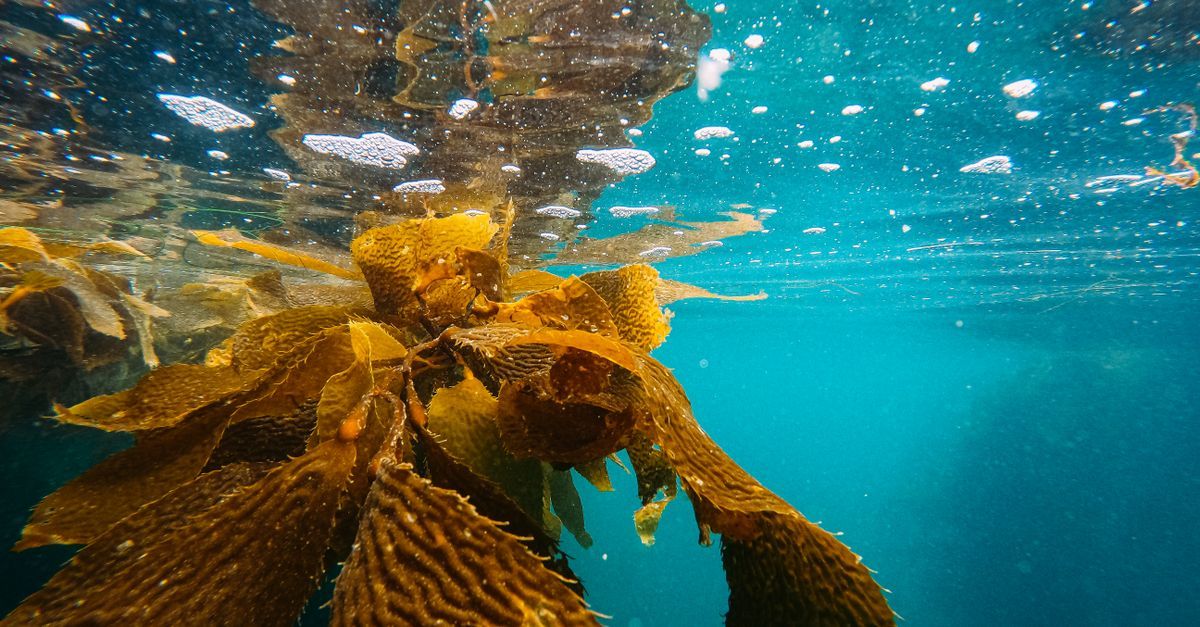
Kelp forests are one of the few ecosystems on Earth built almost entirely in the last century of human memory, yet their scale rivals a forest on land: towering canopies that can reach the surface from a rocky seafloor 20 meters down, creating shade, shelter, and structure for an entire community. Unlike a coral reef, which takes centuries to build its structure, a kelp forest can regrow from nearly bare rock in a single growing season — which is exactly why what happens to its key predator species matters so much.
What kelp actually is
Despite the name, kelp is not a plant — it's a large brown algae. It lacks true roots, stems, and leaves; instead, a root-like "holdfast" anchors it to rocky substrate, a flexible stem-like "stipe" rises toward the surface, and blade-like structures capture sunlight for photosynthesis. Many kelp species, including giant kelp, use gas-filled bladders called pneumatocysts to keep their blades floating near the sunlit surface, which is what allows the forest canopy to form.
Why kelp forests need cold, nutrient-rich water
Kelp forests form along temperate coastlines where cool, nutrient-rich water — often driven by coastal upwelling — supports extremely fast growth. Some kelp species are among the fastest-growing organisms on Earth, with growth rates that can exceed 30 centimeters per day under good conditions. That speed lets a kelp forest largely regenerate within a single season after storm damage, but it also means the ecosystem depends on consistently cool water; marine heatwaves that push water temperatures too high can stall kelp growth across an entire region at once.
The otter-urchin-kelp relationship
The clearest example of a keystone species anywhere in the ocean lives in a kelp forest. Sea urchins graze on kelp holdfasts and can kill entire kelp plants if their population isn't controlled. Sea otters prey heavily on urchins, keeping their numbers in check. When otter populations are healthy, kelp forests tend to be as well. When otters are removed — through historical overhunting, disease, or other pressures — urchin populations can explode and graze a kelp forest down to bare rock, a transformed state scientists call an "urchin barren." The sea otter is currently listed as Endangered on the IUCN Red List.
| Condition | Healthy kelp forest | Urchin barren |
|---|---|---|
| Otter presence | Present, controlling urchin numbers | Absent or reduced |
| Kelp cover | Dense canopy | Little to none |
| Urchin density | Low to moderate | Very high |
| Fish and invertebrate diversity | High | Sharply reduced |
A real example: Northern California's kelp loss
Marine heatwaves, the loss of urchin predators (including sea stars affected by wasting disease), and reduced sea otter numbers in some regions have driven major kelp loss along the Pacific coast. Northern California alone lost more than 80% of its historic kelp forest cover in under a decade, a scale of change that reshaped local fisheries and coastal ecology. Research on sea otter reintroduction and recovery shows that rebuilding otter populations measurably improves kelp forest resilience, underscoring how tightly this ecosystem depends on a single predator relationship.
A bigger footprint than most people realize
Kelp forests rarely get the public attention that coral reefs or rainforests do, but research reviewing coastal ecosystems globally has described kelp and other seaweed forests as covering roughly a third of the world's coastlines, making them one of the most extensive coastal ecosystem types on Earth even though they're easy to overlook from land. Scientists are still working to map that extent precisely country by country, but studies in regions like Australia's roughly 8,000-kilometer Great Southern Reef and the rocky coasts of the Nordic countries have found kelp forests storing meaningful amounts of carbon, adding another reason researchers argue they deserve more attention in global conservation planning, not less.
Who else lives in a kelp forest
- Garibaldi fish and rockfish sheltering among the kelp fronds
- Harbor seals hunting through the canopy
- Abalone grazing understory algae — several abalone species are now Critically Endangered or Endangered on the IUCN Red List
- Understory red and brown algae filling in lower light layers beneath the canopy
The holdfast itself is a habitat in miniature. Because it grips the rock in a dense, tangled mass rather than a single root, a mature holdfast accumulates sediment and organic debris in its gaps, creating a sheltered microhabitat for small crustaceans, worms, and brittle stars that would otherwise have nowhere to hide on open rock. Surveys of individual holdfasts have found dozens of small invertebrate species living inside a single one, making it one of the more overlooked biodiversity hotspots within the broader kelp forest ecosystem.
Common mistakes about kelp forests
Common mistakes:
- Calling kelp a plant — it's algae, with a different structure and evolutionary history.
- Assuming urchins are simply "bad" for the ecosystem — they are a normal part of a healthy kelp forest food web; the problem is unchecked urchin populations, not urchins themselves.
- Thinking kelp loss is permanent everywhere — some kelp forests recover quickly once cooler water returns and predator populations rebuild, while others shift into a more stable urchin barren state.
- Confusing kelp forests with seagrass meadows — seagrass is a true flowering plant that typically grows in softer sediment, not on rocky substrate.
Frequently asked questions
Is kelp a plant?
No. Kelp is a large brown algae, not a true plant. It lacks roots, stems, and leaves in the botanical sense, using a holdfast, stipe, and blades instead, but it photosynthesizes and functions ecologically like an underwater forest canopy.
Why are sea otters important to kelp forests?
Sea otters prey on sea urchins, which graze on kelp holdfasts. Without otters, urchin populations can explode and strip entire kelp forests down to bare rock, a state known as an urchin barren.
How fast does kelp grow?
Some kelp species are among the fastest-growing organisms on Earth, with growth rates that can exceed 30 cm per day under good conditions, allowing forests to regenerate quickly after storm damage or grazing.
Are kelp forests declining?
In many regions, yes. Marine heatwaves, loss of key predators, and urchin overgrazing have driven major kelp loss in parts of the Pacific coast, including a documented decline of more than 80% of historic kelp forest cover in Northern California in under a decade.
Sources
- IUCN Red List — Enhydra lutris (Sea otter) conservation status, accessed November 4, 2026. iucnredlist.org
- The Conversation — "A forgotten and neglected ecosystem covers a third of Earth's coastlines," reporting on global kelp/macroalgal forest research, accessed November 4, 2026.