
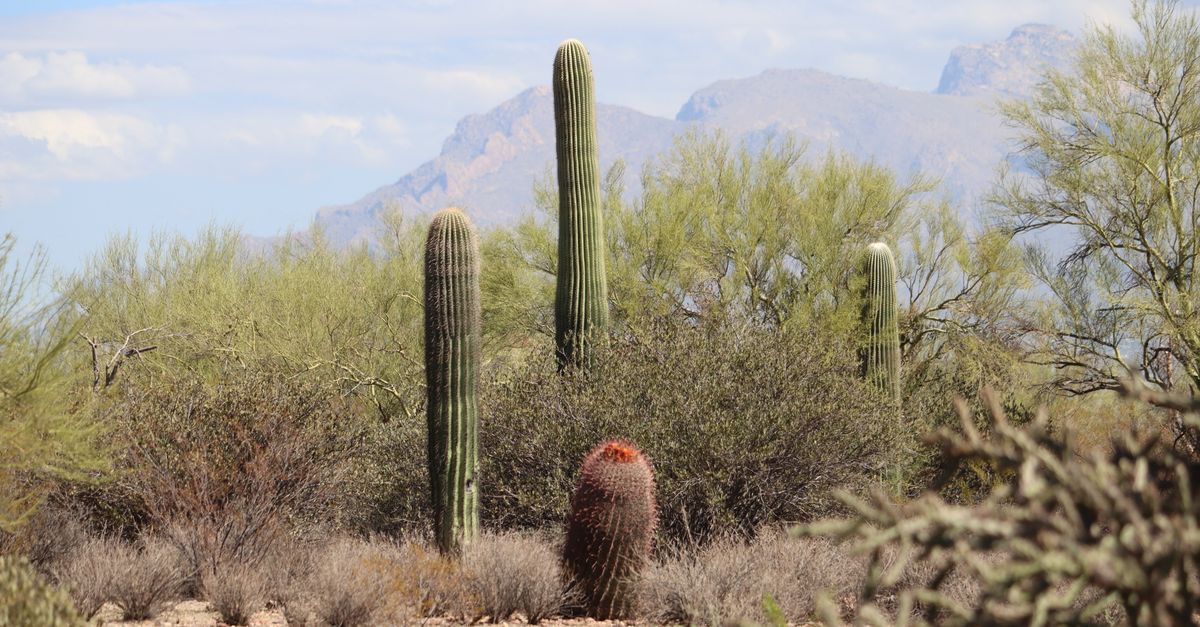
Hot deserts are defined less by heat and more by scarcity: scarcity of water, scarcity of nutrients, and — outside of brief rainfall pulses — scarcity of readily available energy for most of the food web. Every organism that lives there, from a saguaro cactus to a sidewinder rattlesnake, has evolved a specific strategy for coping with that scarcity.
Hot deserts occur across Africa, North America, Asia, and Australia, and despite their different locations they share a recognizable set of conditions and survival strategies. This article explains the climate and soil behind hot desert ecosystems, how plants and animals survive there, and what the latest data says about one of the biome's most studied reptiles.
Climate: low, unpredictable rainfall and extreme swings
Hot deserts typically receive under 250 mm of rain per year, often in brief, intense downpours rather than steady rainfall, separated by long dry periods that can stretch for months or years. Mean annual temperatures run around 20–25°C, but daytime extremes can reach 45–49°C, while nights can be surprisingly cold because dry air and sparse vegetation hold very little heat once the sun goes down. That daily swing between extremes is one of the most physically demanding aspects of desert life.
Soil: thin, mineral-rich, and fast-draining
Desert soils are generally thin, poorly developed, and low in organic content, often sandy, rocky, or capped with a hard mineral crust. Without consistent moisture, organic matter barely accumulates, which keeps nutrient cycling slow. What soil there is tends to drain quickly, so what little rain falls rarely stays near the surface for long — plants either capture it fast or lose access to it.
Productivity: the lowest of any major biome
Hot desert is consistently ranked as the least productive terrestrial biome. Reference estimates put net primary productivity commonly in the range of roughly 10–250 g of carbon per square meter per year, with a frequently cited mean near 90 g/m²/year, dropping toward almost zero in the most extreme deserts and varying sharply from year to year depending on rainfall.
Flora and fauna built around water scarcity
Plant life includes columnar cacti like the saguaro, drought-deciduous shrubs such as creosote bush, true succulents, and short-lived annual wildflowers that stay dormant as seeds until a rare rain triggers rapid germination and flowering. Animal life is equally specialized: the Mojave desert tortoise (Gopherus agassizii), an indicator species for the health of the biome, is classified as Critically Endangered on the IUCN Red List (accessed November 4, 2026). Other residents include the fennec fox, the sidewinder rattlesnake, camels, and darkling beetles, which can harvest water droplets directly from fog in some desert regions.
The desert food web
Sparse producers — cacti, drought-adapted shrubs, and ephemeral annuals — support a food web concentrated around brief productivity pulses that follow rain. Seed-eating rodents and insects form a crucial middle layer, converting plant matter into a food source for reptile and mammal predators. Because decomposition is slow in dry conditions, scavengers play an outsized role in recycling nutrients compared to wetter biomes.
| Attribute | Hot Desert | Tundra |
|---|---|---|
| Limiting factor | Water | Heat / growing season length |
| Productivity | Lowest of any biome | Also very low |
| Key survival strategy | Water storage, nocturnal activity | Insulation, short growth bursts |
How to recognize a hot desert ecosystem
- Sparse, widely spaced vegetation with large areas of exposed soil, sand, or rock.
- Succulent plants (cacti or similar) storing water in thick stems or leaves.
- Little to no leaf litter or organic soil buildup.
- Animal activity concentrated at dawn, dusk, or night to avoid peak heat.
- Sudden, short-lived blooms of wildflowers after rare rainfall events.
Threats and conservation
Habitat loss from development and off-road vehicle use, along with climate-driven increases in heat and drought stress, are major pressures on hot desert ecosystems. The Mojave desert tortoise's Critically Endangered status, per the IUCN's most recent assessment we reviewed, is often used as a broader signal of desert ecosystem health, since the species depends on a specific, undisturbed desert habitat structure to dig burrows and forage.
Common mistakes
- Assuming deserts are lifeless. Hot deserts support highly specialized, often very old lineages of plants and animals — they are low-biomass, not empty.
- Thinking all deserts are hot. Aridity, not temperature, defines a desert; cold deserts exist with very different thermal conditions.
- Expecting rain to fall evenly. Desert rainfall is often extremely uneven year to year, which matters more to desert ecology than the long-term average alone.
Frequently asked questions
How little rain does a hot desert actually get?
Hot deserts generally receive under 250 mm of rain a year, often arriving as brief, heavy downpours rather than steady rainfall.
Why are desert nights so cold if the days are so hot?
Dry desert air and sparse vegetation hold very little heat. Once the sun sets, heat radiates back into the atmosphere quickly, producing large daily temperature swings.
What is the conservation status of the Mojave desert tortoise?
It is classified as Critically Endangered on the IUCN Red List, with habitat loss, development, and climate stress among the leading pressures.
How do desert plants survive with so little water?
Strategies include succulence (storing water in stems and leaves), deep or wide-spreading roots, and, for annual wildflowers, staying dormant as seeds until rain triggers rapid growth.
Are all deserts hot?
No. This article covers hot deserts specifically; cold deserts also exist, with similarly low rainfall but much colder temperatures. Aridity, not heat, defines a desert.
Sources
- IUCN Red List — Gopherus agassizii (Mojave desert tortoise). Accessed November 4, 2026. tortoise-tracks.org
- UC Museum of Paleontology, Berkeley — The Desert Biome. Accessed November 4, 2026. ucmp.berkeley.edu