
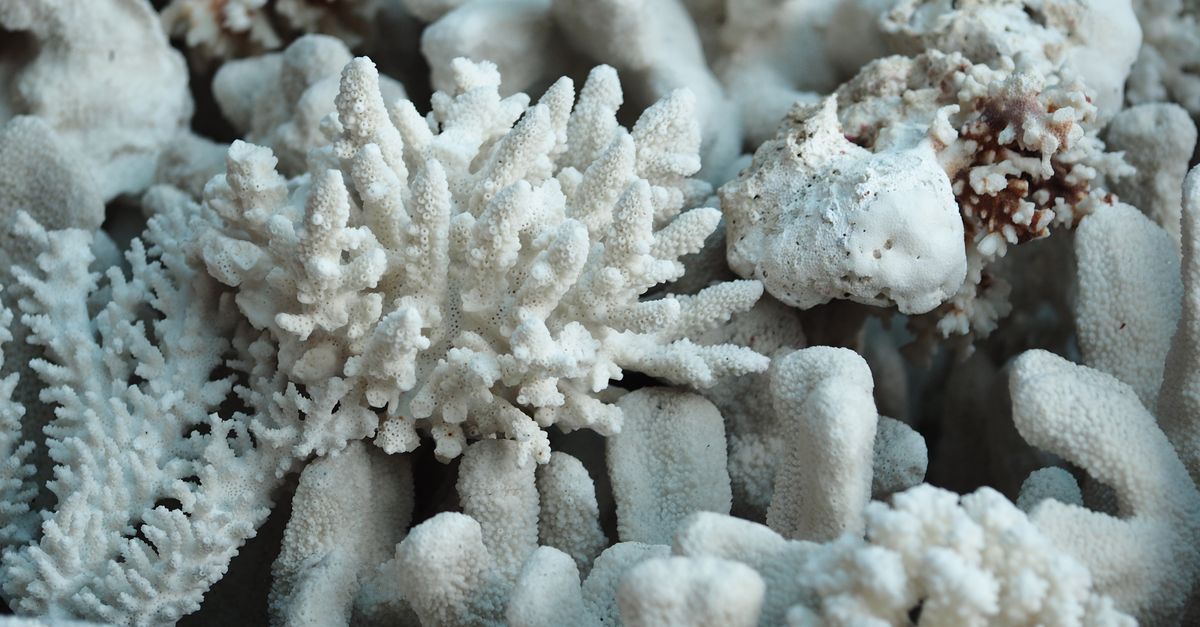
"Bleaching" sounds like a one-time event, but it is really a warning sign — the visible result of a coral under so much stress that it breaks off its most important partnership. Understanding what bleaching actually is, and isn't, matters because the term gets used loosely in the media, often as a stand-in for "the reef is dead," which is not quite right.
What happens inside a bleaching coral
As explained in our article on coral reef structure, coral polyps host microscopic algae called zooxanthellae, which photosynthesize and share food with their coral host in exchange for shelter. That algae is also what gives coral its color. When water temperature rises even 1–2°C above the normal summer maximum for a sustained period — typically measured in "degree heating weeks" — the coral's stress response causes it to expel the algae. Without pigment, the white calcium carbonate skeleton shows through the now-transparent tissue, which is why the coral looks bleached white.
Bleaching is not automatically death
A bleached coral is a starving coral, not necessarily a dead one. Zooxanthellae normally supply most of a coral's energy, so a bleached colony is living off reduced reserves and whatever it can capture by feeding directly. If water temperatures drop back to normal reasonably quickly, corals can reabsorb or regrow their algae population and recover color and health over weeks to months. If the stress is prolonged, severe, or repeated before the coral has time to recover, the colony starves and dies, and the skeleton is then colonized by algae and other organisms.
What triggers bleaching, beyond heat
- Sustained above-normal sea surface temperature — the dominant cause worldwide.
- Unusually low tides that expose shallow reef flats to air and sun for extended periods.
- Sudden drops in salinity after extreme rainfall or freshwater runoff.
- Pollution and sediment runoff, which add chronic stress that lowers a coral's heat tolerance.
How big is the current bleaching event?
According to NOAA Coral Reef Watch, bleaching-level heat stress affected roughly 84% of the world's coral reef area between January 2023 and April 2025 — the most extensive global bleaching event on record, surpassing the previous major global event recorded between 2014 and 2017, which affected an estimated 66% of reef area. Global bleaching events are declared when significant heat stress is recorded across each of the Atlantic, Indian, and Pacific ocean basins within a roughly 365-day period.
| Event | Period | Share of global reef area affected |
|---|---|---|
| Third global bleaching event | 2014–2017 | About 66% |
| Fourth global bleaching event | 2023–2025 | About 84% |
Not every coral on a reef bleaches the same way
Bleaching severity isn't uniform across a single reef. Shallow coral, exposed to the most direct sun and the warmest surface water, typically bleaches first and worst, while coral growing in deeper, cooler water on the same reef slope can escape with little visible damage. Species matter too: fast-growing branching corals like staghorn tend to bleach and die more readily under heat stress, while slower-growing, massive boulder corals are often more heat-tolerant, though not immune. This unevenness is also why a single photo of a bleached reef can be misleading in either direction — it may show the worst-hit shallow patch or a more resilient deeper section, not the reef as a whole.
A practical example: why repeated bleaching is worse than one event
A reef that bleaches once and gets 8–10 years of stable, cooler conditions afterward can often largely recover — new coral recruits settle, colonies regrow, and fish communities rebound along with the structure. The harder problem is "bleaching stacking": when heat stress events happen close together, reefs don't get the recovery window they need. Each successive event affects an already-weakened reef, so cumulative damage builds even if no single event looks catastrophic on its own.
Can scientists help coral survive heat stress?
Researchers are testing several interventions aimed at buying reefs time while ocean temperatures keep rising. Selective breeding programs cross coral colonies that survived past heat waves, in an effort to propagate more heat-tolerant strains on reefs that have already suffered repeated bleaching. Some labs are experimenting with "assisted evolution," exposing coral or their algae symbionts to gradually rising temperatures in controlled tanks to encourage heat tolerance before transplanting them back onto a reef. Coral nurseries — underwater or land-based structures where fragments are grown before being replanted — are now used in reef restoration projects in multiple countries, though scientists are clear that none of these approaches can outpace bleaching at the current rate of ocean warming on their own; they're treated as a way to preserve genetic diversity and buy reefs time, not a substitute for reducing the heat stress that causes bleaching in the first place.
Common mistakes when talking about bleaching
Common mistakes:
- Treating "bleached" and "dead" as the same thing — bleaching is a stress response, not automatically a death sentence.
- Assuming bleaching only happens during unusual heat waves — it now occurs on a near-annual basis in some regions as baseline ocean temperatures rise.
- Thinking local action alone can prevent bleaching — reducing local pollution helps coral resilience, but heat stress is driven by ocean-wide temperature trends.
- Assuming all coral species respond the same way — heat tolerance varies significantly between species and even between colonies of the same species.
Frequently asked questions
Is bleached coral dead coral?
Not necessarily. Bleached coral has lost its algae and turned white, but the coral animal is still alive. If water temperatures return to normal quickly enough, coral can regain its algae and recover. Prolonged stress leads to starvation and death.
What causes coral bleaching?
The main trigger is sustained above-normal water temperature, which causes coral polyps to expel the symbiotic algae living in their tissue. Other stressors, including extreme low tides, pollution, and sudden salinity changes, can also cause bleaching.
How long does it take coral to recover from bleaching?
Recovery can take years to over a decade if conditions improve and the coral was not too severely stressed. Reefs hit by repeated bleaching events in close succession often cannot fully recover between events.
How much of the world's coral has been affected by bleaching recently?
NOAA Coral Reef Watch reported that bleaching-level heat stress affected roughly 84% of the world's coral reef area between January 2023 and April 2025, the most extensive global bleaching event on record.
Sources
- NOAA Coral Reef Watch — Global coral bleaching event data, accessed November 4, 2026. coralreefwatch.noaa.gov